The real limit to AI adoption
It’s not technology, but our capacity to learn
There is a principle in Aikido, called ‘awase’, which I have always understood as a way of being in relation to what is unfolding in front of you. It is often translated as ‘blending intention’ or ‘blending energy’, though even that language can make it sound more deliberate and controlled than it actually is in practice.
In lived experience it is closer to a form of disciplined receptivity, where you are neither collapsing into passivity nor asserting force against force, but instead adjusting yourself so precisely to ‘the reality of the moment’ that resistance, and oppositional energy, becomes unnecessary.
It is not a theory of harmony. It is a practice of attention under pressure.
When I sit with that idea for long enough, it becomes easy to see its relevance to the current moment in artificial intelligence and the way institutions are attempting to absorb it.
The dominant narrative tends to orbit around tools, capability, productivity gains, and transformation roadmaps, yet beneath all of that there is a quieter and more difficult question about whether systems, and the people within them, are actually able to meet what is emerging without defaulting to force or rigidity.
We are now operating in a context where the half-life of knowledge is collapsing in real time. It has long been observed in medicine that a significant proportion of what is learned during training will be revised or replaced within a relatively short window, yet what is different now is not the existence of that phenomenon but its acceleration. In the context of AI, what once felt like a multi-year cycle of obsolescence is compressing into months, sometimes weeks, where yesterday’s fluency becomes today’s partial understanding.
This is not simply a matter of keeping up with new information. It is a structural shift in what it means for knowledge to function as an asset at all.
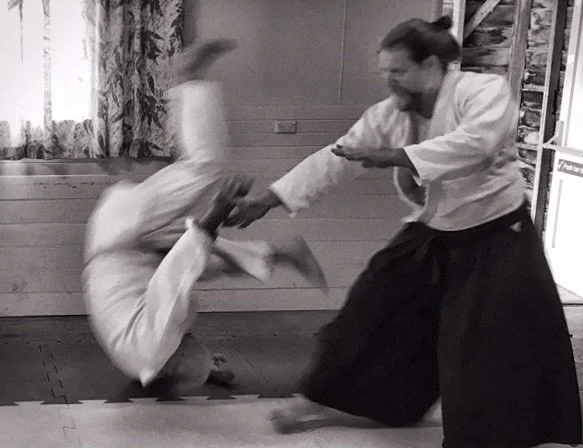
“Meeting change through alignment rather than force”
Training at the Farm Dojo
If the rate of change outside an organisation consistently exceeds the rate of learning inside it, then decline is not a dramatic event, it is an administrative outcome.
The difficulty is that most of our institutions are still organised around the assumption that knowledge is something you acquire, stabilise, and then deploy. Our dominant learning architecture still privileges completion, where value is attached to having finished a degree, obtained a certification, or mastered a defined body of content. It is a model built around possession, and in stable environments it works well enough to produce competence and predictability.
What it struggles to accommodate is the reality of continuous displacement, where the ground underneath expertise is no longer stable long enough for possession to remain meaningful.

George Leonard’s framing of ‘mastery’ becomes particularly useful here, not as a romantic idea of expertise, but as a description of how learning actually behaves when it is no longer linear.
The plateau, which he describes as the long periods where apparent progress is minimal, is often misread in organisations as ‘stagnation’. However, in practice it is frequently where integration is happening. Where skill becomes embodied rather than merely understood.
Most systems are designed to reward movement rather than continuity, which is why most people are incentivised to leave the plateau rather than inhabit it.
The shift that becomes necessary for mastery, is not cosmetic. It is a movement from completion towards continuity, from knowledge ‘as a finished object‘ towards learning as ‘an ongoing practice’, and from intensity bursts of capability development towards a sustained discipline of return.

The Discipline of Return
AikiLife Dojo, Phillip, ACT
In Aikido there is no final technical completion that releases you from practice. The assumption is almost the reverse, that competence is always provisional and must be continually re-embodied through a return to the mat.
What becomes apparent over time is that the difficulty is not usually the learning itself. Most people are capable of learning new techniques, absorbing new ideas, or adapting to changing conditions. The deeper challenge is sustaining the orientation required to remain open, curious, and responsive once the initial energy of novelty fades and the plateau begins.
This is where structured practice matters.
Not as remediation, and not as a sign that someone is failing, but as a way of maintaining the conditions under which adaptive capacity can remain active over time.
In elite sport this is understood almost instinctively. No serious athlete assumes that talent or occasional insight alone is sufficient for long-term development. Coaching, repetition, feedback, and reflective practice are not peripheral supports to performance; they are the infrastructure that allows performance to endure under changing conditions.
Organisational life often treats coaching differently, as though it exists primarily for correction, recovery, or executive refinement at the margins. Yet if the central capability required in the age of AI is continuous learning, then coaching begins to look less like an intervention and more like scaffolding. It provides a relational structure that helps people remain engaged with uncertainty long enough for deeper learning to occur.
Because learning, particularly in conditions of volatility and ambiguity, is not simply cognitive. It is emotional, behavioural, relational, and at times existential. People need spaces where experimentation is possible, where uncertainty can be metabolised rather than concealed, and where identity can adapt without collapsing into defensiveness.
In that sense, coaching is not separate from learning practice. It is one of the conditions that makes sustained learning possible.
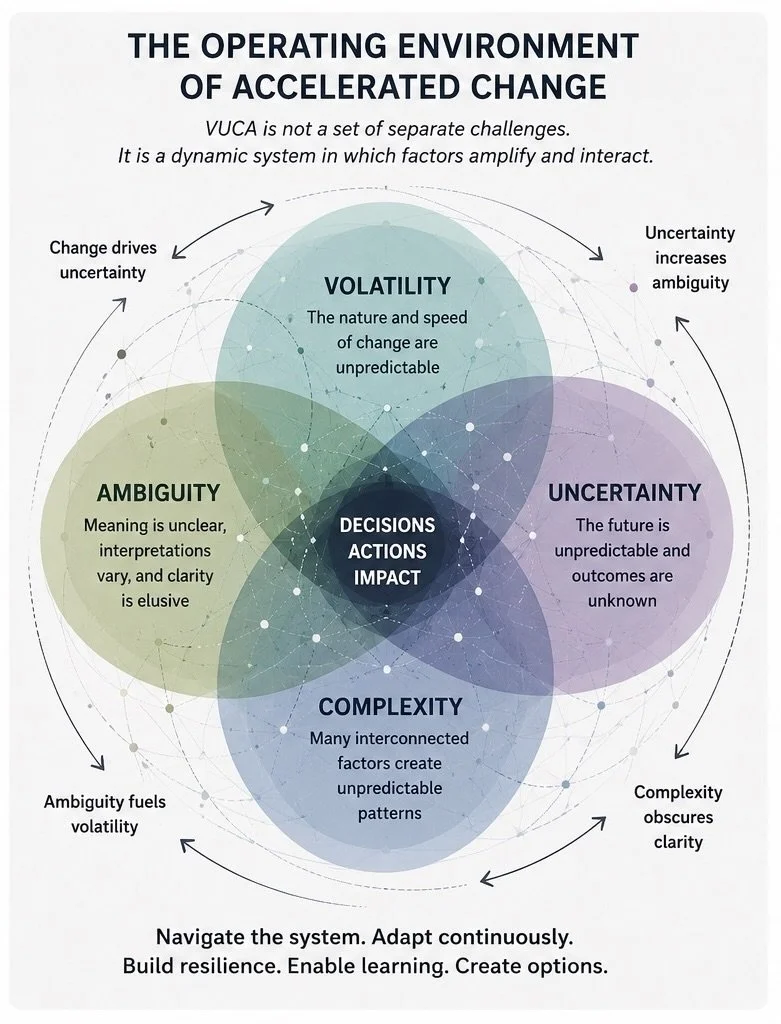
‘The operating environment of accelerated change’
The familiar shorthand of VUCA becomes less of a conceptual framework and more of a lived environment.
The temptation in such environments is to treat the problem as complicated rather than complex, which leads to a predictable set of responses centred on expertise, planning, and best practice transfer. These approaches are not incorrect, but they are insufficient when the underlying domain is not stable enough for repeatability to function as the primary learning mechanism.
It is important here, to look at another framework, the Cynefin framework, because it becomes useful here as it makes visible a distinction that is often invisible in organisational decision-making, namely the difference between domains where analysis produces reliable solutions and domains where learning only emerges through action.
In complex systems, understanding does not precede action in a linear way. It emerges from iterative engagement, where safe-to-fail experimentation becomes the mechanism through which patterns can be perceived.
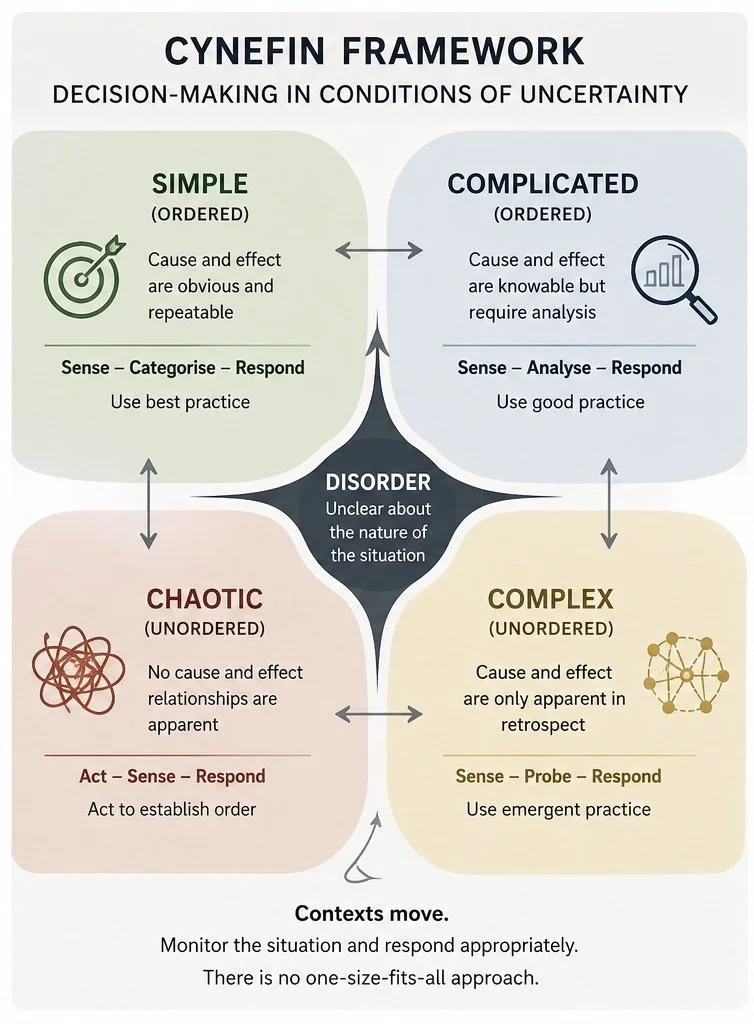
‘Decision making in conditions of uncertainty’
What this means in practical terms is that organisational responses built solely on training programs, expert deployment, or codified ‘best practice’ will inevitably underperform in environments characterised by rapid change. These tools are still valuable, but they are incomplete unless they are paired with mechanisms for real-time experimentation and feedback.
Learning, in complex domains, is not something that happens before action, it is something that happens through action.
This is where the conversation becomes more difficult, because the real barrier to AI adoption is rarely technical capability. It is not that people cannot learn new tools or adapt to new systems. It is that doing so requires a shift in identity that is often more demanding than the acquisition of new skills.
When knowledge loses its stability, identity structures that have been built around being the one who knows begin to destabilise as well. The expert identity, the authority identity, and the role of the one who provides certainty become harder to maintain in environments where certainty itself is continuously eroding.
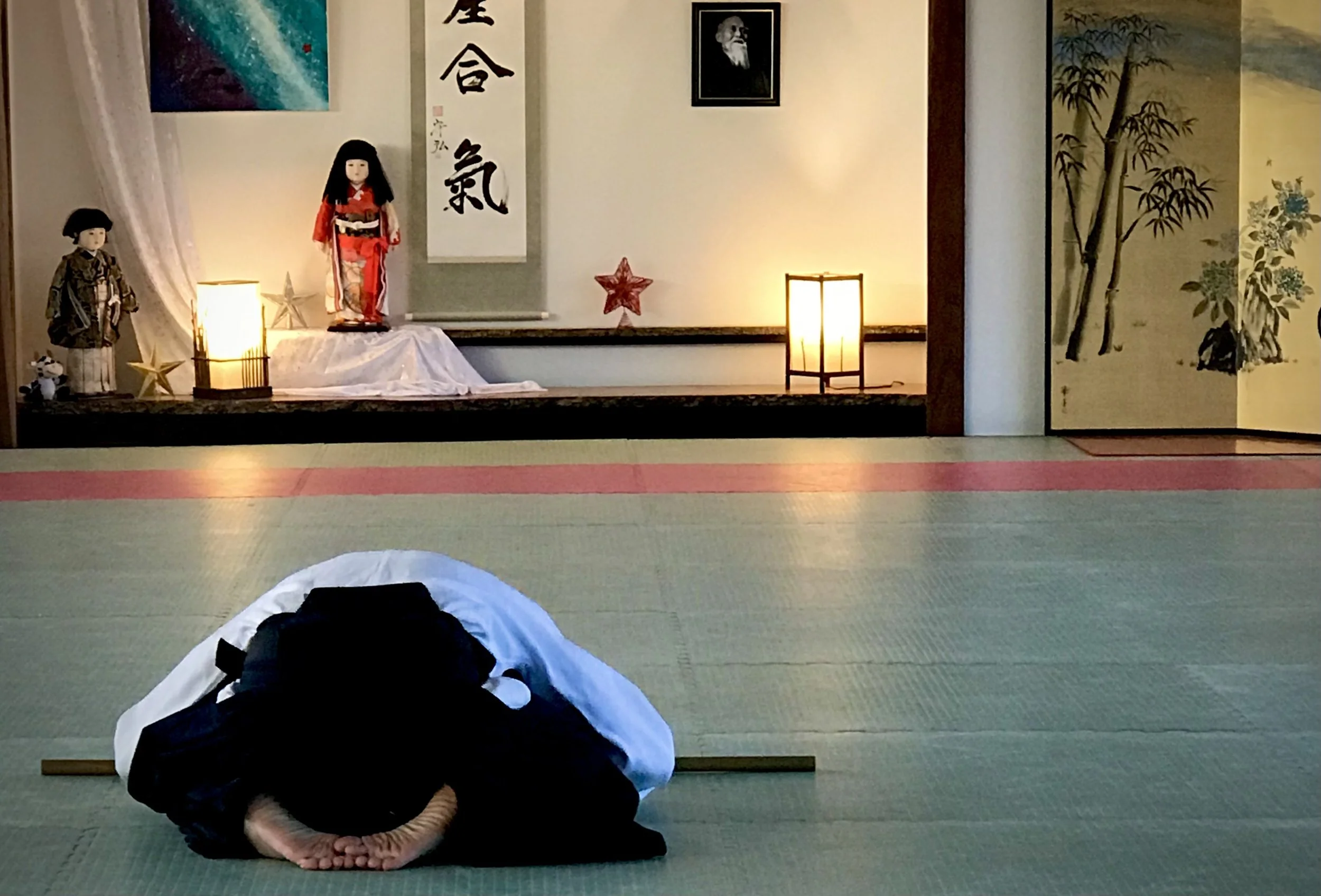
‘The dissolution of fixed identity in practice’
AikiLife Dojo, Phillip, ACT
The instinctive response is to protect that identity by narrowing engagement, reinforcing familiar tools, and avoiding contexts where one’s competence might be temporarily suspended. This is not irrational, it is psychologically coherent, but it becomes limiting when sustained over time.
The deeper shift is not from ignorance to knowledge, but from identity as ‘knower’ to identity as ‘learner’, particularly a learner in service of others rather than in pursuit of personal certainty.
Leadership in this context cannot be reduced to having better answers, because the system itself no longer reliably supports stable answers for long enough to anchor decisions around them. Instead, leadership becomes increasingly about the design of conditions in which learning can occur at speed and without fear of exposure.
When leaders optimise for certainty, they inadvertently suppress the very behaviours required for adaptation, including experimentation, disclosure of uncertainty, and iterative learning. When they optimise for learning, they create environments where mistakes are treated as information rather than failure, and where capability can compound over time rather than fragment under pressure.
This is not a cultural add-on. It is an infrastructural requirement for operating in AI-accelerated environments.
In the end, what persists is not knowledge in its static form, but the capacity to return to practice. The discipline of returning becomes the only stable advantage in environments where tools, systems, and even domains of expertise are continuously in motion.
Leonard’s mastery curve is helpful here precisely because it removes the expectation of constant ascent. It reframes development as cyclical, where plateaus are not deviations from progress but part of its structure.

‘Leaderhip as the design of learning’
The question therefore is not whether individuals or organisations will encounter plateaus in capability. The question is whether they will remain in relationship with them long enough for learning to continue.
In Aikido, there is no final moment of arrival that ends practice. There is only practice itself, repeated, refined, and re-entered, each time in slightly different conditions, each time requiring a renewed capacity to meet what is actually present.
What emerges from that is a more restrained conclusion than most narratives about AI transformation prefer, but also a more durable one. In a world where knowledge expires with increasing speed, the only sustainable advantage is the cultivation of systems, both personal and institutional, that treat learning not as an event but as a continuous, embodied practice.
Many organisations are investing heavily in AI capability, platforms, and tooling. Far fewer are investing with equivalent seriousness in the human capacity that determines whether any of it will matter, which is the ability of people to learn, unlearn, and reconstitute their identity in real time as learners.
If there is a final thread that holds this together, it is the recognition that in environments shaped by AI acceleration, mastery is no longer about accumulation of knowledge, but about sustaining the discipline of return, where learning remains active long after certainty has dissolved.