man’s search for meaning
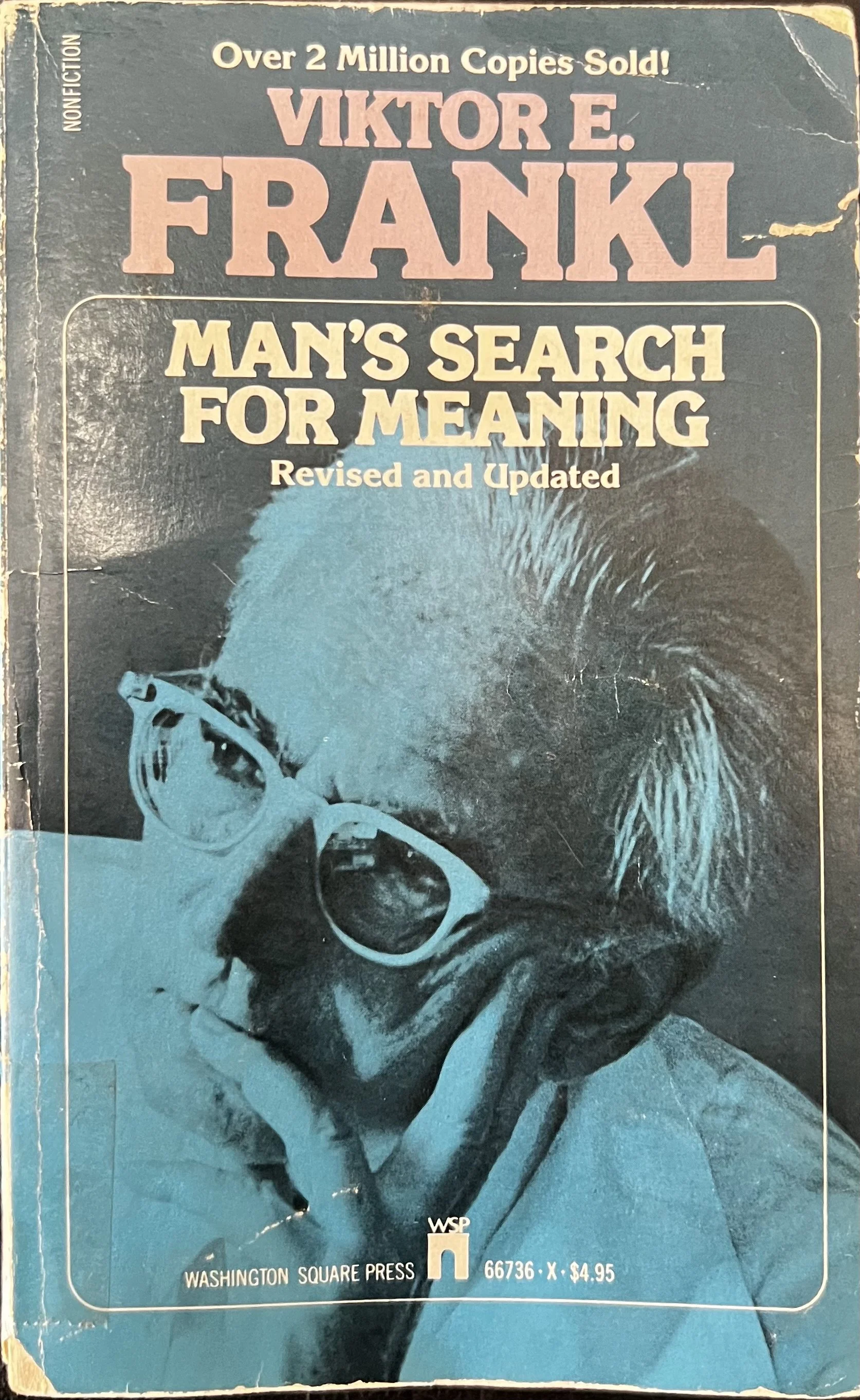
Viktor Frankl’s book, Man’s search for meaning, from the Insightful Path Library
More than thirty years ago, as a young man searching for purpose, I picked up a book whose title alone seemed to speak directly to me: Man's Search for Meaning.
The title of this book alone, caught my attention, and once I picked it up, the story resonated so deeply, I read it in one sitting, writing in the margins and quickly trying to find as much as I could on the author - Viktor Frankl. The book has become an important touchstone for me, when I am feeling adrift from my purpose, and is, without a doubt, a part of my ‘Syllabus of Life’.
In Man’s Search for Meaning, Frankl, an Austrian psychiatrist, chronicles his experiences as a prisoner in the concentration camps, and what he discovered there about the human need for purpose and meaning, even under the most brutal of situations.
The first part of Man's Search for Meaning recounts Frankl's personal experiences in the camps, describing the physical and psychological toll on the prisoners. He observed that those who could find meaning in their suffering, whether through love, work, or spiritual beliefs, were more likely to survive.
Frankl was fascinated by what it was that enabled humans to maintain their humanity, even in the face of extreme difficulty. What it was that allowed them to find meaning, and use this to survive. And he recounts stories, both of his own endeavours as well as those of others who were able to do this and, I felt upon reading this, that he encouraged me to explore my own ability to maintain humanity in the face of difficulty, to access my ‘best-self’ and bring this to help me in life when he said the following:
“Do not think that these considerations are unworldly and too far removed from real life. It is true that only a few people are capable of reaching such high moral standards. Of the prisoners only a few kept their full inner liberty and obtained those values which their suffering afforded, but even one such example is sufficient proof that man’s inner strength may raise him above his outward fate. Such men are not only in concentration camps. Everywhere man is comnfronted with fate, with the chance of achieving something through his own suffering.”

Quote that touched my soul, from page 86 of the book.
Frankl’s story, and example so inspired me. “How?!”, I wondered was someone able to see what he saw, endure what he endured, and still come out of that experience with such clarity, such insight, such hopefulness for the world, and strength in his own human value?
I knew that nothing I would ever do would compare with Frankl’s example, but that too inspired me to find as many insights as I could to enable me to make a difference in the world, no matter how small. Frankl also said that this decision, to hold onto an almost moral or spiritual purpose would be the decision that helps one from succumbing to the ‘degenerating influences’ of difficult times. As a 20 (something) year old, intent on ‘saving the world’ (a desire of the young and naive), this was something I wanted to remember.
“We have stated that that which was ultimately responsible for the state of the prisoner’s inner self was not so much the enumerated psychophiscial causes as it was the result of a free decision. Psychological observations of the prisoners have shown that only the men who allowed their inner hold on their moral and spiritual selves to subside eventually fell victim to the camp’s degenerating influences. The question now arises, what could, or should, have constituted this inner hold? ”
The second part introduces Frankl’s psychological theory, logotherapy. Frankl states, at the front of this section, that the task to summarise his theory was not easy. The original treatise on logotherapy took 20 volumes in its original German, while the summary within Man’s Search for Meaning is a concise 60 pages. In this, Frankl suggests that the primary drive in human life is not pleasure (as Freud suggested) or power (as Adler proposed) but the pursuit of meaning.
Frankl explains that meaning can be found through creating and achieving something of meaning, or experiencing and encountering love and beauty within relationships, or even developing resilience by choosing one’s attitude in the face of pain and hardship which are unavoidable.
In essence, this book, named in 1991 as one of the 10 most influential books in the US (by the Library of Congress) emphasises that life has meaning under all circumstances, even in suffering, and that individuals can find purpose by choosing how to respond to life's challenges.
WHy I recommend this book
Each time I return to Man's Search for Meaning, I am reminded why it has remained part of my 'Syllabus for Life' for more than three decades. Reading, and re-reading this book is a humbling experience. And built within me a sense of responsibility to connect with, and use, my ‘best self’ in order to better walk the Insightful Path.
Even today, decades after first reading it, I find myself returning to Man's Search for Meaning whenever I need to reconnect with what truly matters. Each reading reminds me that purpose is not something we discover once, but something we choose repeatedly through our actions, our relationships, and the way we respond to life's inevitable difficulties.
Continue your exploration
The search for meaning is not confined to a single book. Many of the ideas Frankl explores (purpose, responsibility, resilience, service, and the cultivation of one’s character) appear throughout other books, articles and resources on Insightful Path. If Frankl’s ideas on purpose, resilience, and the freedom tho choose your responses resonated with you, these books offer thoughtful companions along that same journey:
Related Books:
Mastery- on embracing the lifelong discipline of growth through patient, deliberate practice.
The Art of Loving - On discovering that love is not simply a feeling, but a discipline requiring courage, responsiblity, and care.
The Anatomy of Human Destructiveness- on understanding both humanity’s capacity for cruelty, and its equally remarkable capacity for compassion and choice.
Related Insights
Frankl's work has influenced many of the reflections I have written on purpose, leadership, resilience, and what it means to live a life of service.
Human Destructiveness - a post exploring the warnings of control, conformity, and quiet surrender of self through examination of modern classics.
Standing at the threshold- post examining what it takes to speak truthfully when the stakes are high.
Recreating a narrative of hope - a post on radical hope in the face of cultural devastation and the use of narrative can help one to reclaim their sense of purpose.
I think we need hope:A reflection on how meaning, responsibility, and the stories of those who have endured remind us that hope is less an emotion than a practice of choosing to continue.
PUtting these Ideas into practice
Frankl's work continues to shape the way I coach, facilitate, and design learning experiences by encouraging people to reconnect with purpose, responsibility, and the freedom to choose how they respond when circumstances are difficult.
Executive coaching - supporting leaders to reconnect with purpose, exercise wise judgement, and respond thoughtfully during periods of uncertainty and change.
Leadership development-helping leaders cultivate responsibility, self-awareness, and the character needed to lead with purpose.
Facilitation and its design - creating environments where people can reflect deeply, think together, and discover shared meaning through conversation.
Beyond the book
The ideas in Man's Search for Meaning continue to influence not only my professional work, but also my understanding of service, mindfulness, learning, and what it means to live a meaningful life.
The Insightful Path – reflections on my ‘syllabus of life’, my ‘path with heart’, and ‘the origin of the ‘Insightful Path’
Learning what can not be taught – exploring how humility is an essential element to leadership, and is in recognition of the fragility that certainty creates.
Interviews with Thoughtful Leaders – conversations with practitioners whose work continues to deepen my understanding of leadership, purpose, and what it means to live well.