CONCERNING DISSENT AND CIVIL DISOBEDIENCE

‘Dissent is critical for a well functioning society’
From the Insightful Path Library
THE LEADERSHIP PROBLEM
As I read the morning news, I’m struck by a recurring tension in modern governance.
Systems appear procedurally intact, legally sound, and institutionally stable… yet the boundaries between judicial authority, political influence, and moral judgment very much seem to be less distinct in practice.
For leaders operating inside these systems, especially in the public sector, this creates a difficult question:
Where does principled influence end, and inappropriate entanglement begin?
My Dad was a history teacher. When he died, I inherited many of his books. Places I return to when I’m trying to better understand what I’m seeing. One of the books, marked now by both of us, is Concerning dissent and civil dissobedience by Abe Fortas.
Fortas is an instructive figure. Associate Justice of the United States Supreme Court. Close advisor to President Lyndon B. Johnson. A central figure in some of the most consequential legal and political tensions of the Warren Court era.
Fortas did not reject the system. He worked within it.
And that is precisely why his career remains useful. Not as a story of failure, but as a study in constraint, proximity, and judgment under pressure.
At the heart of the book is a tension that remains highly relevant::
How do you hold a system together while allowing it to be challenged?
Too much dissent, poorly held, can fragment institutions, while too little dissent, or dissent that is quietly suppressed, produces something more dangerous:
compliance without conviction
alignment without trust
stability without legitimacy
This is how systems begin to lose their capacity to correct themselves.

‘inviting dispute’
From the Insightful Path Library
THE BOOK IN ONE IDEA
Dissent does not must mean disagreement from outside the system. It is a critical function of the system, and one of the ways the system works.
Fortas is very clear:
“The question is not ‘may I dissent?’… I may dissent. I may criticise. I may oppose. Our Constitution and our courts guarantee this.”
He reinforces this by citing Justice Douglas, who says:
“A function of free speech… is to invite dispute. It may indeed best serve its high purpose when it induces… unrest… or even stirs people to anger.”
Together, these form a kind of key. Dissent is not polite, contained, nor necessarily comfortable, It is, at times unsettling, provocative, and disruptive of equilibrium. And that is not a failure of the system. It is evidence that the system still allows itself to be questioned.
Fortas expands this beyond spoken dissent, to include:
protest
symbolic action
peaceful assembly
organised opposition
and ultimately, participation through the ballot box
These are not peripheral rights. They are operational mechanisms of legitimacy.
WHY IT MATTERS HERE
If dissent is a core mechanism of legitimacy, then the critical questions becomes, ‘What conditions allow dissent to function effectively within a system?’
This shifts the focus from principle to practice. Now whether dissent is allowed, but how it is expressed, received, and whether it can meaningfully influence outcomes.
This is where institutional design, and institutional independence, become critical.
Fortas is clear:
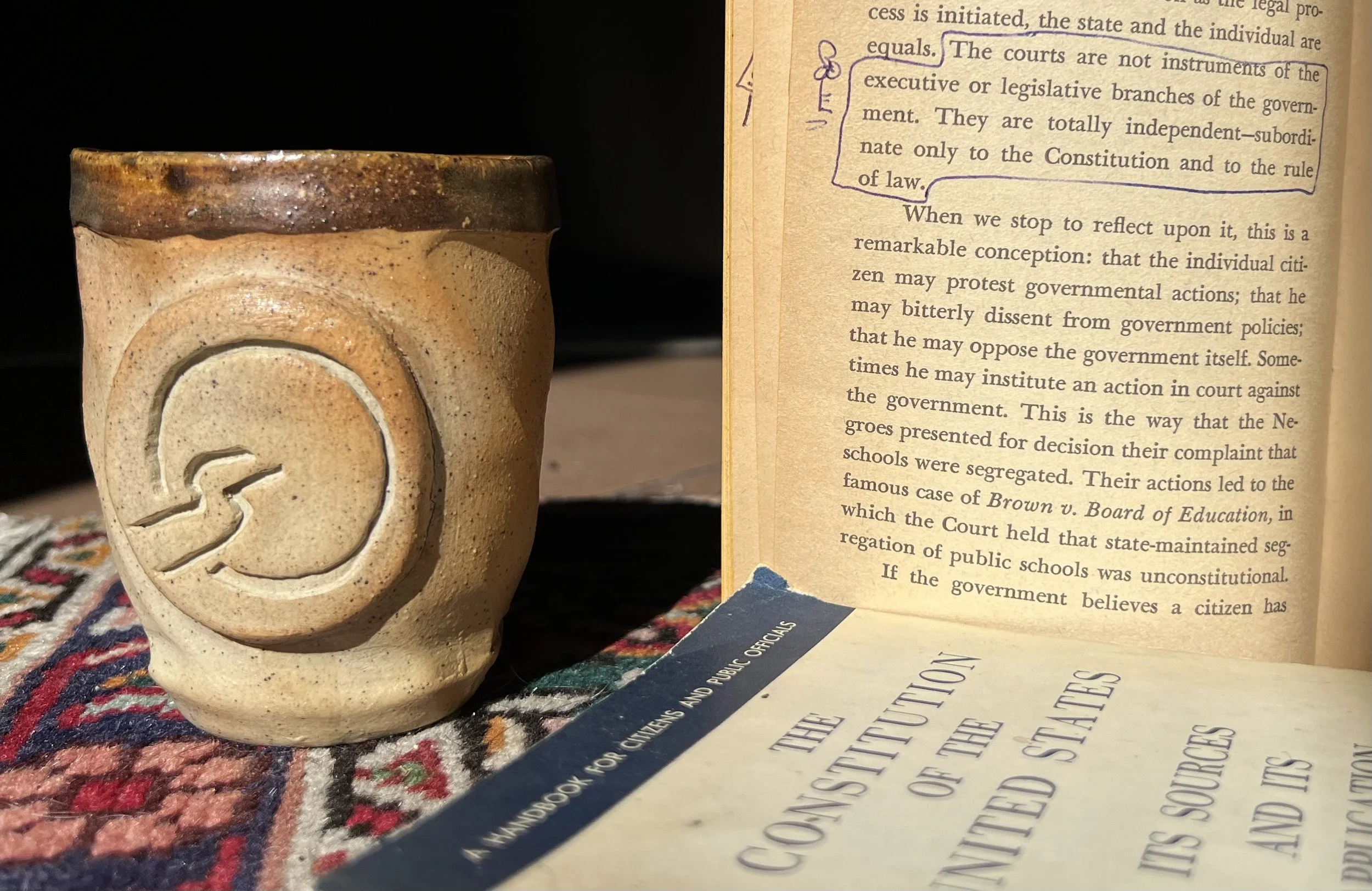
‘the courts are not instruments of the executive’
From the Insightful Path Library
“The courts are not instruments of the executive or legislative branches… They are totally independent—subordinate only to the Constitution and the rule of law.”
If that independence holds, dissent has somewhere to go.
If it weakens (legally, procedurally, or culturally) then dissent does not disappear. It becomes:
less visible within the system
more difficult to resolve
and potentially more destabilising over time
This is not theoretical.
Recent developments, such as the U.S. Supreme Court decision in Louisiana v. Callais (April 2026), illustrate how the conditions for dissent can shift.
The move from assessing discriminatory outcomes to requiring proof of intent appears technical.
But in practice, it changes:
what can be challenged
how it must be proven
and how likely it is to succeed
At the same time, remedies that explicitly account for structural imbalance are increasingly constrained.
The effect is not the removal of dissent.
It is a narrowing of its effective pathways.
Which raises a practical leadership question:
When formal avenues for challenge become more constrained, where does dissent go?
It does not disappear. It adapts. Often becoming less visible inside the system… before becoming more forceful outside it.

‘how wonderful our freedom to dissent!’
From the Insightful Path Library
WHERE IT HOLDS / WHERE IT DOESN’T
Fortas is at his strongest when he grounds dissent in lived democratic practice. He points to the civil rights movement not as an abstraction, but as evidence:
“that ordinary citizens—without formal power, without institutional control—were able to drive profound social change through the disciplined use of dissent.”
He describes a period where those without conventional power, held no office, controlled no institutions, and owned no major platforms… yet through marches, boycotts, organised protest, and persistent public expression, they reshaped the direction of a nation.
This is not romanticism. It is evidence.
“That dissent, exercised collectively and with discipline, can shift systems that appear immovable. [and importantly] It does so without violence—because it has other instruments available.”
This is one of Fortas’s clearest contributions. Dissent is not the alternative to order. It is the alternative to violence.
Regardless of how you judge Fortas later history, he is right in at least one important respect:
Real governance is not purely institutional… it is also relational.
Power does not operate only through formal authority. It operates through proximity, trust, and access. And in that sense, Fortas understood something many leaders still underestimate:
decisions are shaped in informal spaces
influence is often exercised outside formal roles
outcomes are frequently determined before official processes begin
However, where his model becomes fragile is in the assumption that proximity to power can remain neutral if intent is good. This is where modern leadership experience is less forgiving.
Intent does not stabilise structure.
Structures shape behaviour over time… even for well-intentioned actors. And proximity changes perception:
what risks feel reasonable
what boundaries feel flexible
what exceptions begin to feel normal
This is not a moral failure. It is a systemic one which has moral consequences.
Where the book requires careful reading is in the complexity of dissent in modern systems.
Not all dissent is informed, constructive, or oriented toward the common good. And not all systems are equally capable of absorbing it.
Which means the leadership task is not simply to defend dissent in principle.
It is to develop discernment:
when dissent is revealing something real
when it is amplifying distortion
and how to engage it without either suppressing it or being captured by it
Fortas gestures toward this in his emphasis on disciplined protest, policing, and disciplined adherence to law:
“An enormous degree of self-control and discipline are required on both sides [for effective dissent].”
This is often overlooked.
Dissent is powerful… but only when it is exercised within a framework that preserves the possibility of a shared system.
WHAT TO DO WITH IT
For leaders, Fortas’s argument translates into a set of practical responsibilities:
1. Notice where dissent becomes harder to express
The early signal is not prohibition, but hesitation. What is not being said? What is consistently softened? What is deferred or avoided?
2. Maintain clear boundaries between dissent and harm
Dissent crosses a line when it:
turns toward violence
materially interferes with the rights of others
or seeks to overthrow the system by force
3. Strengthen legitimate pathways for challenge
Dissent requires structure to remain effective:
formal avenues for critique
protected spaces for disagreement
visible responsiveness to raised concerns
Without these, dissent either dissipates, or escalates.

‘The Constitution protects all classes of men, at all times, under all circumstances’
From the Insightful Path Library
4. Protect institutional independence in practice, not just in principle
If insititutions cannot act independently, dissent loses its most effective point of engagement.
5. Manage proximity to power deliberately (Fortas’s lived lesson)
Separate advisory influence from decision authority
Be explicit about your role in moments of tension
Treat access as a risk, not just an advantage
Build structural distance, not just personal restraint
WHO SHOULD READ THIS
This is a case for leaders operating near power, not just within formal authority:
senior public servants
advisors and policy designers
judicial and quasi-judicial actors
executives in government-adjacent roles
those working in governance, law, or institutional design
leaders navigating reform, resistance, and public trust
reformers working through institutional proximity
It is especially relevant for those whose effectiveness depends on access to decision-makers.
It is less useful as a legal text, and more useful as a framework for thinking about legitimacy under pressure.
CLOSING REFLECTION
It would be easy to read Fortas’s argument in isolation. To treat it as clean. Principled. Structurally sound. But Fortas himself complicates that reading.
He operated at the highest levels of institutional power:
deeply connected to political leadership
closely embedded in decision-making networks
And later, his career became entangled in ethical controversy that led to his resignation. That matters, not because it invalidates his argument; but because it sharpens it.
Fortas’s life reflects the same tension his book explores from another direction, systems depend on boundaries, but those boundaries are maintained by people operating under pressure, proximity, and incentive.
It is possible to:
understand the system deeply
believe in its principles
and still become shaped by the forces within it
This is not simply hypocrisy, but a reminder:
Integrity in systems is not static. It is something that must be continually navigated.
And this brings the focus back to the reader.
The question is not, ‘Was Fortas right?’, or even ‘Was Fortas flawed?’
The more useful question is:
Given the pressures, incentives, and proximity that come with influence… how confident am I that I could maintain the boundaries the system relies on?

‘The rock of our political salvation’
From the Insightful Path Library
A FINAL THOUGHT
Most institutional failure does not arrive through dramatic breach. It arrives through incremental redefinition of what feels normal inside the role.
Fortas’s story is not about one moment. It is about accumulation.
And for anyone working inside systems of influence today, that is the more uncomfortable (and more useful) lesson.
Dissent, in Fortas’s framing, supports the system. Not because it agrees with the system, but because it ensures the system remains open to being questioned… and therefore capable of remaining legitimate.
CONTINUE YOUR EXPLORATION
Concerning Dissent and Civil Disobedience is worth returning to because Fortas reminds us that healthy societies depend not upon the absence of disagreement, but upon the presence of legitimate ways to express it. His reflections remain relevant wherever leaders seek to balance institutional stability with openness to challenge, and where questions of power, legitimacy, and public trust continue to evolve. Fortas's ideas become even richer when read alongside other works that explore democratic stewardship, moral courage, institutional integrity, and the responsibilities of leadership.
RELATED BOOKS
No single book captures the challenges of protecting free societies. Douglas explores how institutions can gradually lose legitimacy when freedom, participation, and moral imagination are eroded. His ideas become even richer when read alongside authors who examine courage, conscience, power, and democratic responsibility.
Points of Rebellion - William O. Douglas: For readers interested in how democratic institutions retain legitimacy, and why freedom, participation, and institutional trust must be actively stewarded.
Profiles in Courage - John F. Kennedy: For readers interested in the moral courage required to remain faithful to conscience while serving within democratic institutions.
Self-Reliance - Ralph Waldo Emerson: For readers interested in the disciplined judgement required to think independently while remaining responsible to something larger than oneself.
RELATED INSIGHTS
The questions Fortas raises continue to influence my own thinking about leadership, governance, institutional integrity, and the conditions that allow disagreement to strengthen rather than weaken the systems we serve. These reflections explore many of the same questions through public service, democratic leadership, and organisational life.
Stewardship: Louder than Words: A reflection on stewardship, institutional integrity, and the responsibility leaders carry to strengthen the systems entrusted to their care.
To those that would lead: A reflection on listening, service, and the quiet forms of leadership through which trust is earned and democratic institutions are ultimately sustained.
The Insightful Path to Good Leadership: A reflection on servant leadership and why authority finds its legitimacy in service to something greater than ourselves.
PUTTING THESE IDEAS INTO PRACTICE
Fortas reminds us that healthy institutions depend not only upon good laws, but upon leaders capable of holding power, disagreement, and responsibility with integrity. His ideas continue to shape how I approach leadership development, executive coaching, and the design of collaborative learning environments.
Executive coaching - supporting leaders to navigate complexity, maintain ethical judgement, and exercise influence responsibly within systems of authority.
Leadership development- helping leaders cultivate the discernment, integrity, and institutional awareness required to lead through disagreement while maintaining trust.
Facilitation and its design - creating environments where constructive disagreement can strengthen relationships, improve decisions, and build more resilient organisations.
BEYOND THE BOOK
The questions Fortas raises extend well beyond constitutional law. They continue to influence my understanding of leadership, organisational culture, psychological safety, and the importance of creating environments where disagreement can be expressed without undermining the relationships that hold systems together. His work reminds me that healthy institutions are not those without conflict, but those capable of learning from it.