Points of Rebellion
William O. Douglas

‘A voice of experience and responsibility’
From the Insightful Path Library
The Leadership Problem
There is a tension that I am feeling when I look at the leadership challenges for institutions within the public sector all around the globe. To me, it seems that the systems we work within do still function. The processes that have been developed are largely intact. Even the language of fairness, consultation, and accountability remain.
And yet, I am still scrolling the new cycle, feeling unsettled.
Seeing the distance between what is happening to our state of governance, and what is being discussed within the institutions that are there for the people… well, it seems to me that many of those I follow, talk with, and work with are far more cautious now in what they feel comfortable saying. They seem less certain about how ‘safe’ it is, would they to raise their concerns. And, disturbingly, less convinced that their contributions to the conversation would have any hope of changing anything.
This isn’t institutional failure in the obvious sense. But it has happened before, and the lessons are there to learn from if we want to change it. If we want to avoid what appears to be a very negative outcome for our world.
William O. Douglas (Associate Justice of the United States Supreme Court for over three decades) wrote Points of Rebellion in 1970 as both an insider and a critic of the system he served.
His central observation is difficult to ignore:
A system can remain ‘legally sound’… while losing the moral consent that gives it life.
And when that gap opens, dissent doesn’t disappear.
It changes form.
The Book in One Idea
A society that gradually trades freedom, privacy, and fairness for security, efficiency, or progress risks eroding the very legitimacy it depends on.
Douglas’s argument is not abstract. It is grounded in lived reality:
Citizens monitored for beliefs, associations, and ideas
Expanding surveillance powers justified by “national security”
Structural inequality benefiting the few at the expense of the many
And he is clear about what must remain outside institutional reach:
“A man’s belief is his own; he is the keeper of his conscience; Big Brother has no rightful concern in these areas.”
Freedom of thought is not a luxury. It is the foundation of a functioning democracy.That principle hasn’t changed. What has changed is the environment in which it must be upheld.
Robert M. Hutchins captured the broader shift:
“The issue is not how to produce… but how to live human lives… how to make the world a decent habitation for mankind.”
Douglas is asking the same question, more urgently:
What kind of system are we building—and who is it for?
Why It Matters Here
It would be easy to read Douglas as history. He describes a period where individuals were scrutinised for:
The music they listened to
The books and art they owned
The views they held
This isn’t history. The methods may have changed. The dynamics have not.
Where once there were paper files and wiretaps, now there are:
Data capture at scale
Algorithmic profiling
AI systems shaping visibility, opportunity, and perception
Douglas saw this coming:
“Ideological data… is treacherous when fed into a computer… all one has to do now is press the ‘subversive’ button and all the names… come tumbling out.”
Today, the capability is far more advanced. Which makes the question less about intent… and more about design and governance.
Because the risk is not only that information is collected. It is that, over time, people adjust to being observed.
They become more careful.
More aligned.
Less willing to test ideas openly.
Inside organisations, this shows up in familiar ways. Chris Argyris called them the undiscussables;
the truths that cannot be safely spoken without destabilising the system.
When people cannot speak freely:
Foresight narrows
Risk is managed rather than addressed
Participation becomes more cautious than constructive
This is not usually the result of bad intent. It is how systems stabilise themselves under pressure.
Psychological safety, then, is not just an organisational concern.
It is a democratic one.
Where It Holds / Where It Doesn’t
Douglas is remarkably prescient in some areas.
He is right that:
Surveillance, once normalised, expands
Economic inequality destabilises social cohesion
Concentrated power—corporate or political—tends toward self-preservation
His warning about “creeping conformity” feels especially relevant:
“The tendency… is the creation of a creeping conformity that makes us timid in our thinking at a time when the problems… demand bold and adventuresome attitudes.”
That is something that many leaders will recognise in practice.
Where his analysis is less complete is in the nature of dissent itself. Douglas writes in a context where dissent is often framed as a corrective force.
Today, it is more complex. Dissent can illuminate; but it can also fragment, mislead, or be amplified in unhelpful ways. Which means the task is not only to protect dissent, but to engage with it thoughtfully and discern what it reveals.
What To Do With It
Douglas does not offer a ‘call to rebellion’. He offers a reminder of our responsibility.
1. Create conditions where difficult truth can be spoken safely, and raised early
If people cannot speak openly, systems lose the ability to adapt.
Strengthen structured opportunities for reflection (pre-mortems, after-action reviews)
Ensure that raising risk is seen as contribution, not disruption
Pay attention to what is not being said, as much as what is
2. Treat data and AI as moral choices… not just technical ones
Efficiency is not neutral if it erodes freedom.
Be deliberate and transparent about what is collected and why
Question assumptions framed as ‘necessary trade-offs’
Embed ethical oversight into system design
3. Rebuild legitimacy through genuine participation
People disengage when participation feels performative, but they do engage when it is genuine.
Move beyond consultation toward shared problem-solving where possible
Be transparent about constraints and trade-offs
Recognise that voice and agency are part of system effectiveness, not separate from it
Who Should Read This
This is a book for people inside systems—especially those with influence.
Senior public servants and policy leaders
Advisors supporting complex decision-making
Leaders navigating trust, reform, and resistance
Anyone working at the intersection of technology, governance, and ethics
It is less about immediate answers, and more about sharpening judgement.
Closing Reflection
What stood out for me in reading Douglas is not how different his world was… but how the things that feel dystopian today… have already been set in motion before, and have evolved.
People were monitored for what they read, believed, and owned.
Dissent was surveilled.
Power concentrated.
Democracy did not fail.
But it was tested.
And it is still being tested.
Douglas leaves us with a stark choice:
“There are only two choices: a police state… or a society where law is responsive to human needs.”

‘Two choices…’
From the Insightful Path Library
Read carefully, and this is less a prediction than a direction of travel. Systems rarely move abruptly. They adjust incrementally, through decisions that are often reasonable in isolation.
“Only the moral imagination is missing.”
Not the tools. Not the capability. But the willingness to shape systems that remain worthy of the people they serve.
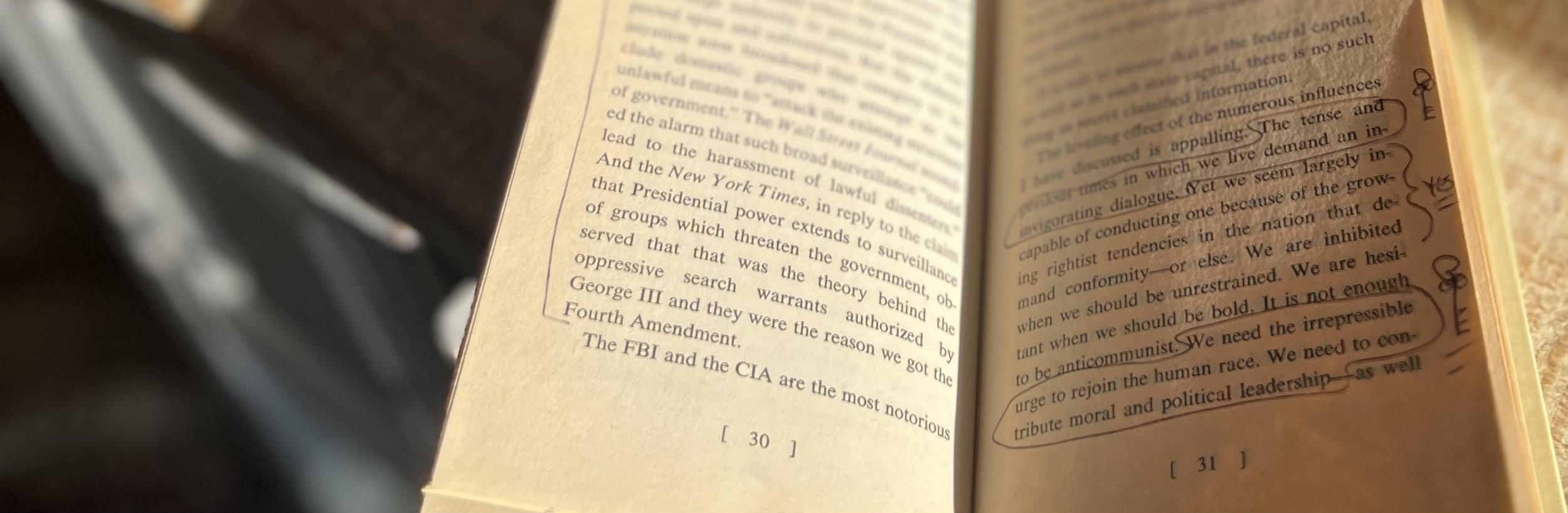
‘An invigorating dialogue’
From the Insightful Path Library
A final thought
In my work, I sit with leaders who are trying to do something that isn’t often named. They are holding systems together, while also sensing where those same systems are no longer working as intended.
That tension is not a failure of leadership. It is The Work of Leadership. And perhaps this is where Douglas is still most relevant. Not as a call to rebellion; but as a reminder that the health of any system depends on its capacity to be examined from within.
Carefully. Honestly. And, at times, courageously.
If you’re working in this space and trying to make sense of these tensions in your own context, I’m always open to a conversation.
CONTINUE YOUR EXPLORATION
Points of Rebellion is worth returning to because it asks one of the enduring questions of democratic life: how do free societies preserve both their liberty and their legitimacy? Douglas reminds us that healthy institutions depend not only on laws and structures, but on citizens and leaders willing to examine them honestly. His reflections become even richer when read alongside other works that explore conscience, courage, institutional stewardship, and the responsibilities of leadership.
RELATED BOOKS
No single book captures the challenges of protecting free societies. Douglas explores how institutions can gradually lose legitimacy when freedom, participation, and moral imagination are eroded. His ideas become even richer when read alongside authors who examine courage, conscience, power, and democratic responsibility.
Profiles in Courage - John F. Kennedy: For readers interested in the moral courage required to remain faithful to conscience while serving within democratic institutions.
Concerning Dissent and Civil Disobedience - Abe Fortas: For readers interested in the legitimate place of dissent within a constitutional democracy, and the responsibilities that accompany both protest and public authority.
The Anatomy of Human Destructiveness - Erich Fromm: For readers interested in understanding how fear, conformity, and the misuse of power shape individeuals, organisations, and societies.
RELATED INSIGHTS
Douglas's reflections continue to shape my own thinking about public service, institutional trust, ethical leadership, and the conditions that allow democratic societies to remain healthy. These essays explore many of the same questions through contemporary leadership, governance, and organisational life.
Stewardship: Louder than Words: A reflection on stewardship, institutional integrity, and the responsibility leaders carry to strengthen the cultures they inherit rather than merely preserve them.
To those that would lead: A reflection on the quiet forms of leadership that grow through listening, service, and genuine care for the people and communities entrusted to us.
The Insightful Path to Good Leadership: A reflection on servant leadership, public purpose, and why leadership ultimately exists in the service of something greater than ourselves.
PUTTING THESE IDEAS INTO PRACTICE
Douglas reminds us that healthy institutions depend upon people who are willing to think independently, speak honestly, and steward systems with integrity. These ideas continue to influence the way I approach leadership, learning, and organisational development.
Executive coaching - supporting leaders to navigate complexity with integrity, strengthen moral courage, and remain thoughtful when institutional pressures encourage conformity.
Leadership development- helping leaders cultivate the judgement, discernment, and ethical responsibility required to build trust within complex organisations.
Facilitation and its design - creating environments where difficult questions can be explored openly, diverse perspectives can be heard, and meaningful participation strengthens better decision-making.
BEYOND THE BOOK
The ideas in Profiles in Courage extend well beyond politics. Kennedy's reflections continue to influence my understanding of public service, leadership, citizenship, and the responsibilities that accompany positions of trust. They have shaped not only the way I think about courageous leadership, but also the questions I continue to ask of myself, the leaders I coach, and the institutions we serve.