The counsel of the chisel
On wisdom, counsel, and knowing when to act
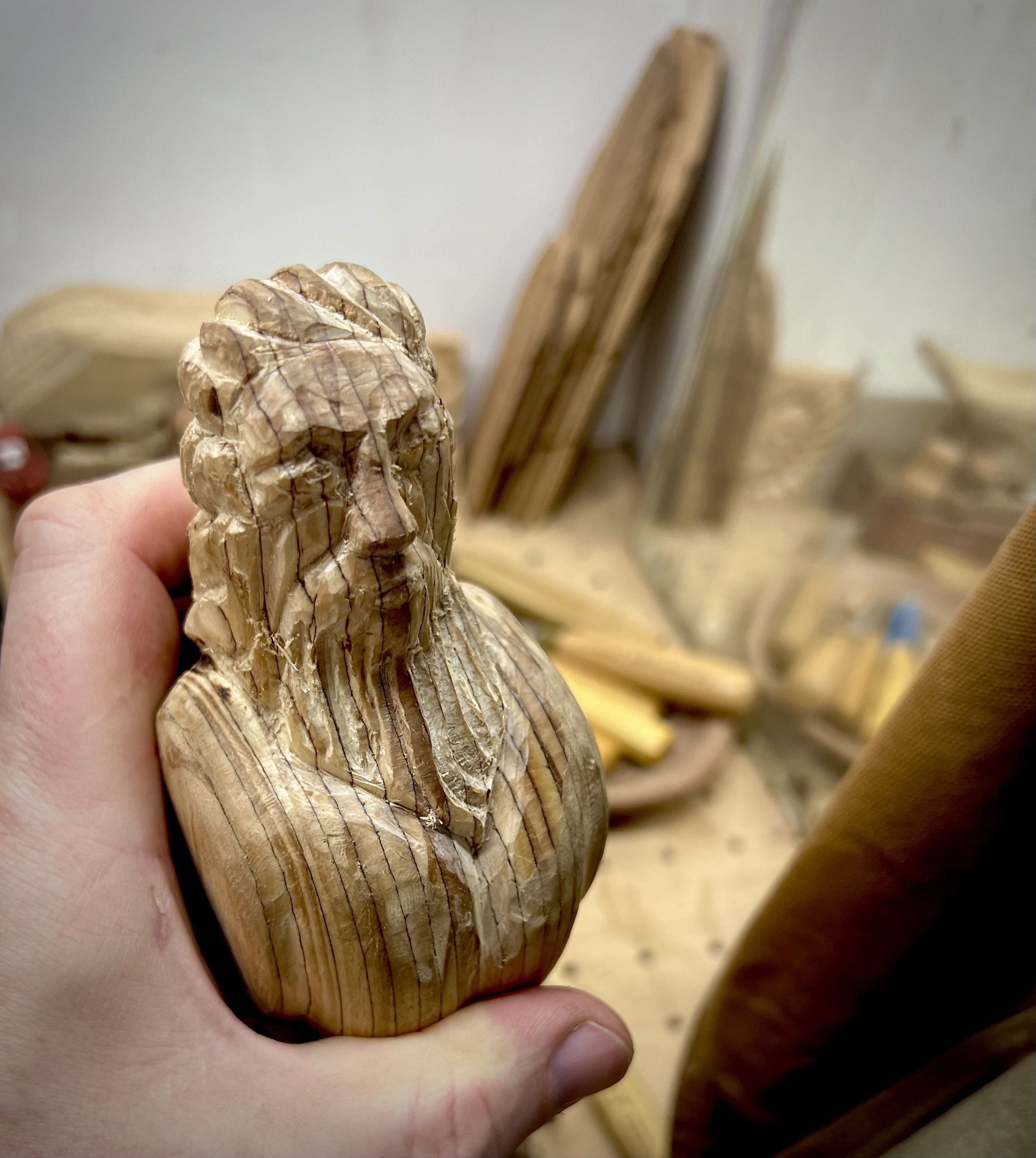
‘Finding the face’
From the Artists’ Woodshed Studio Retreat
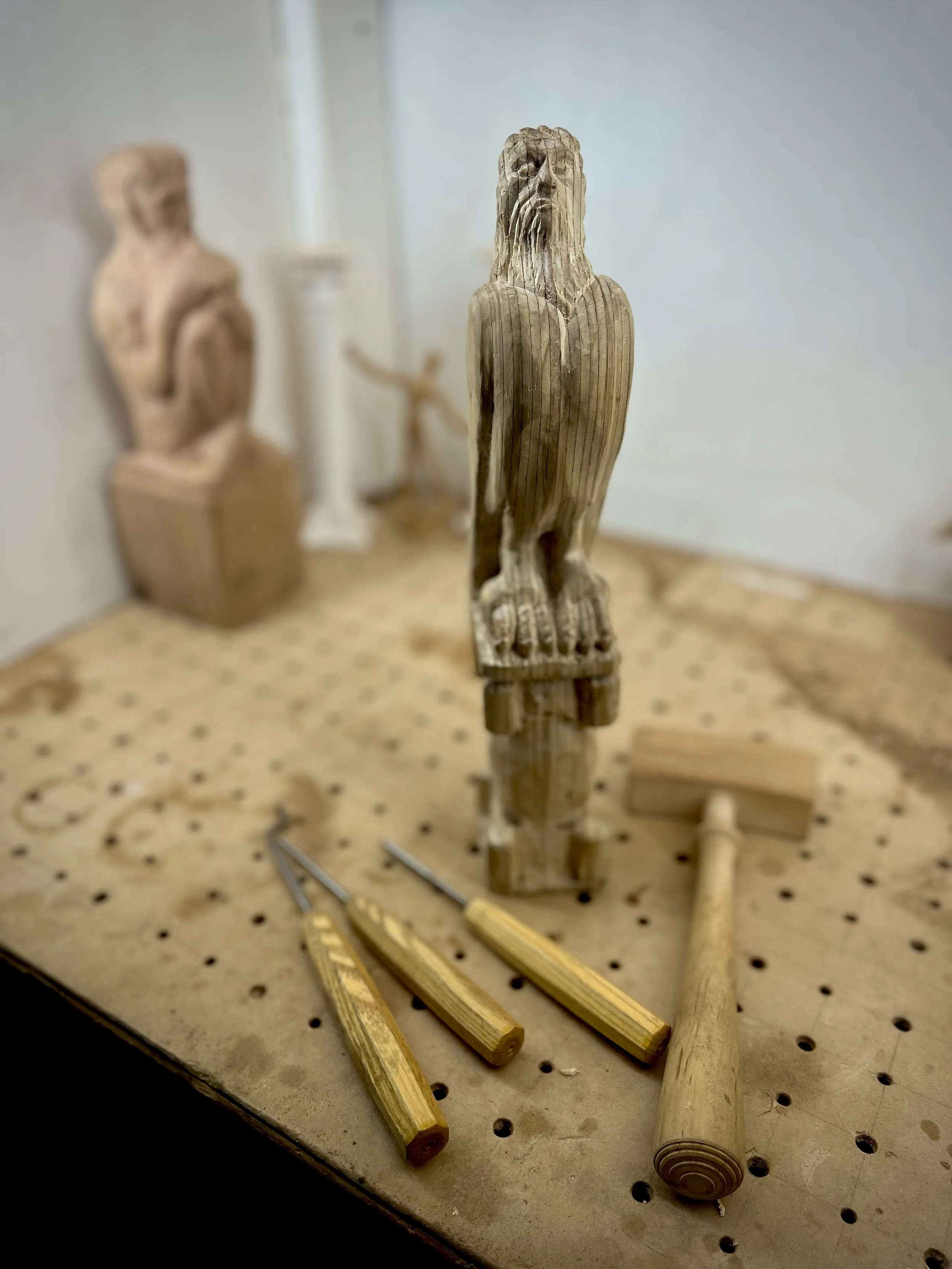
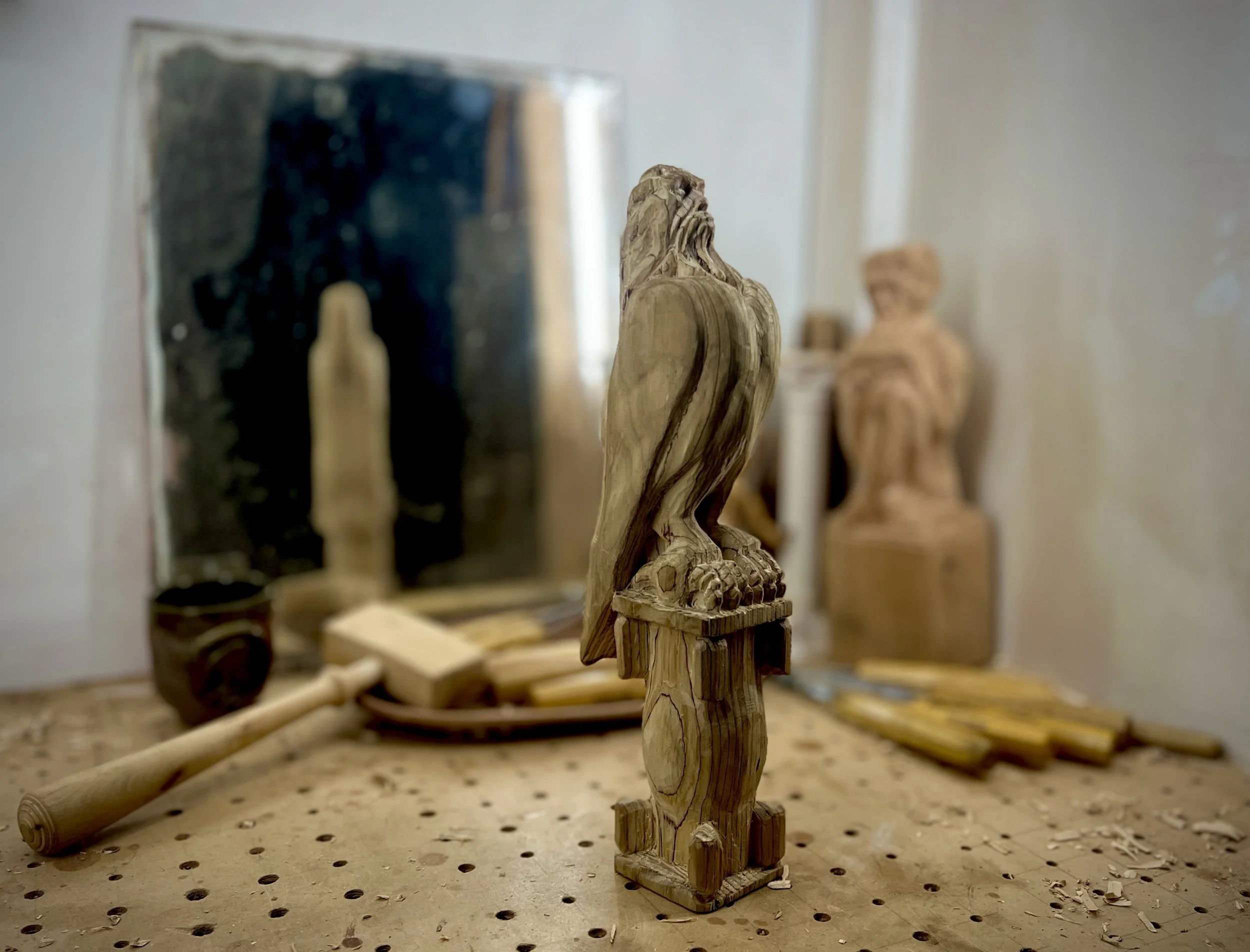
There is an owl on my workbench with his eyes closed.
He is not finished. His feathers are not quite right. His hair and beard need work, as do his feet, and I still haven't quite decided what to do with the Greek column beneath him.
He has been like this for a while.
The wood is not particularly precious. It is an offcut from a laminated timber beam I used to build my son's loft bed. I got the original timber for free from someone dismantling a carport. The chisels are more precious. They belonged to my grandfather: old Swiss carving tools that I keep sharp and bright.
I started the bird several years ago, put him aside, returned to him, put him aside again.
As my carving has improved, so has he.
Or perhaps, more accurately, I have become better able to make what I can see.
An owl from somewhere else
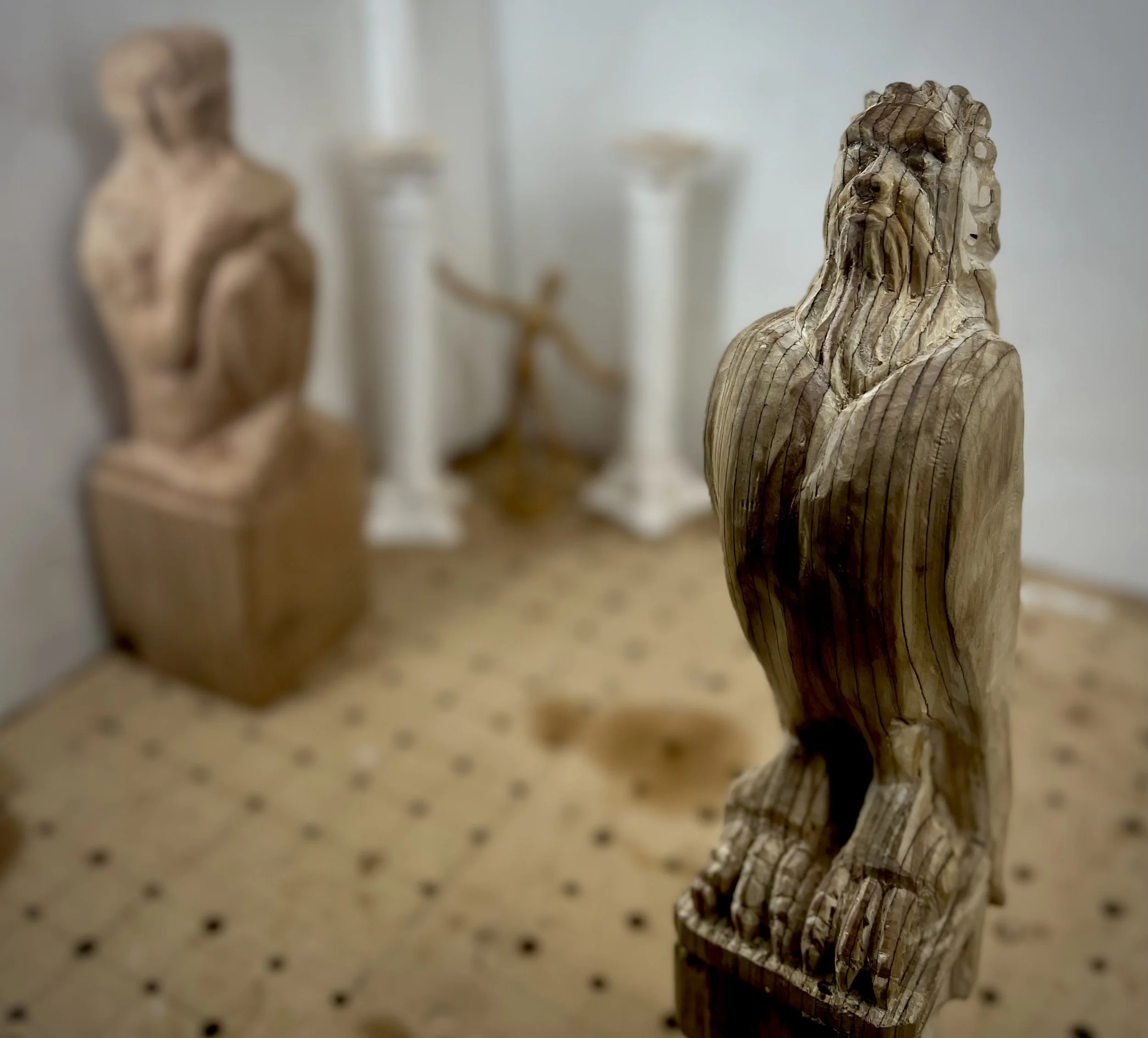
‘Narratives from old’
From the Artist’s Woodshed Studio Retreat
I was eight when Clash of the Titans came out in 1981.
I remember seeing it at the cinema in Minnesota: Harry Hamlin as Perseus, Medusa, the Kraken, Pegasus, gods looking down on mortals and interfering in their lives.
And Bubo.
Bubo was a mechanical owl, one of Ray Harryhausen's creations for the film. Turner Classic Movies He wasn't remotely like the owl I am carving now. He was metallic, slightly ridiculous and funny. Looking back, perhaps there was something of R2-D2 about him.
I loved him.
What stayed with me wasn't a particular scene so much as what Bubo seemed to represent. He was a companion and a guide, sometimes comic, sometimes useful, appearing when Perseus needed him.
At eight, there was something deeply appealing about the idea that the gods might send you something like that.
A counsellor.
Something wise that might appear when you were lost.
That desire has apparently stayed with me longer than I realised.
Athena's bird
The association between Athena and the owl is ancient. Owls appear with her in Greek art and, for centuries, Athenian coins carried Athena on one side and the owl on the other. The Metropolitan Museum of Art
We tend now to reduce Athena to the “goddess of wisdom”, but that description can make wisdom sound passive.
Athena was also associated with strategy, craft and warfare. The kind of intelligence connected with her was not simply the accumulation of knowledge. The Greek tradition contains richer ideas of practical and strategic intelligence: intelligence capable of meeting circumstances, seeing what is happening and working out what to do.
Later, Aristotle would write about phronesis, usually translated as practical wisdom. It concerns the things that can be otherwise: the contingent situations in which there is no complete rulebook and we nevertheless have to decide what to do. Practical wisdom cannot simply be learned as a collection of general rules. It develops through practice and through learning to recognise what a particular situation requires. Stanford Encyclopedia of Philosophy
I like that distinction.
Knowledge matters enormously. But knowledge gives us facts.
Wisdom has something to do with seeing the relationships between them, recognising what matters here and now, and discerning what action the circumstances call for.
That is much harder.
Against the grain
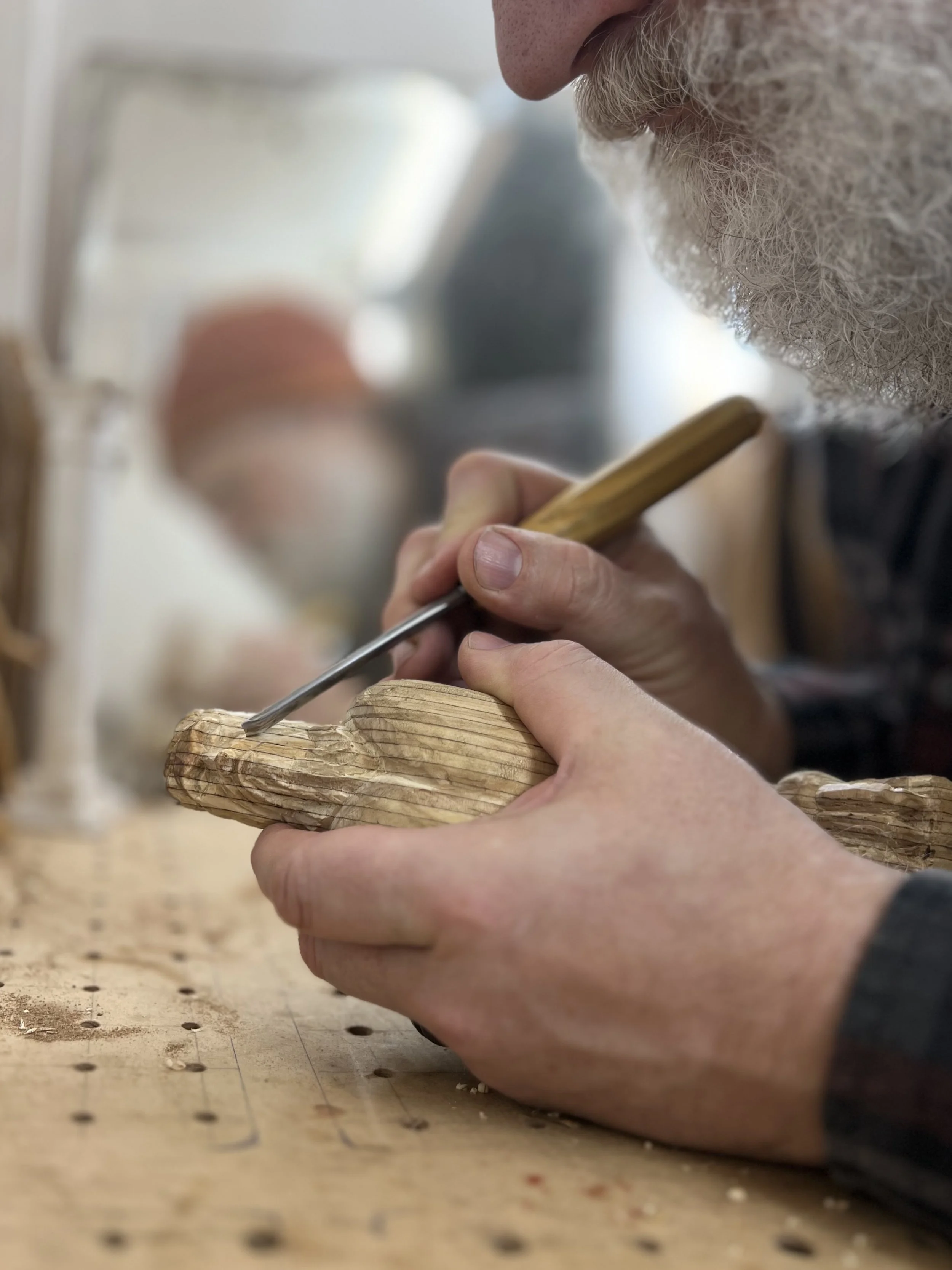
‘Making the cut’
From the Artists’ Woodshed Studio Retreat
Plywood is an interesting material to carve. Each layer has its own grain, often running differently from the one beside it. The glue between the layers behaves differently again. A chisel can be travelling cleanly and then catch the next layer in the wrong direction. A piece flakes away. It cannot be put back.
The only choice is to accept what has happened, and decide what else now needs to come back a little so that the carving can remain in proportion. I have recut this owl's nose, mouth and eyes many times.
There is also a continual judgement about how much to take away. Sometimes I use a large chisel and remove a considerable amount of wood. Sometimes the right decision is a tiny shaving.
And sometimes the right decision is to stop carving.
Fatigue matters. When I get tired, my attention deteriorates. I am more likely to misread the grain or let the tool travel somewhere I did not intend.
None of this means abandoning the form I am trying to make.
In fact, as I become more skilled, I can hold that form more clearly. I understand proportion better. I see the larger shapes before becoming preoccupied with detail. My hands are becoming more capable of making what my mind can see.
But intention meets material.
And then I have to respond.
There is a difference between responding and reacting.
I see it in leadership as well.
Reflection can become paralysis. Action can become thoughtlessness. Neither thinking nor acting is inherently wise simply because we are doing more of it.
The question is whether we can see clearly enough to respond.
Choosing the counsellor instead of the army
‘Waiting’
From the Artists’ Woodshed Studio Retreat
I encountered another version of this problem when I was about seventeen.
Peter Brook's Mahabharata introduced me to Arjuna and Krishna.
Before the great war, both Arjuna and Duryodhana seek Krishna's support. Krishna offers them a choice. One may have his vast Narayana army. The other may have Krishna himself, unarmed and committed not to fight.
Arjuna chooses Krishna.
Duryodhana gets the army. Internet Sacred Text Archive
That story has stayed with me for nearly forty years.
On one level, Arjuna's decision makes very little sense. If war is coming, surely you choose the army. But armies are tools. Power is a tool. Authority is a tool. Knowledge is a tool.
They matter only if we can discern what they are for and how they should be used. Arjuna chooses counsel. And eventually, on the battlefield, he needs it.
The Bhagavad Gita takes place in the extraordinary pause before action. Arjuna is a warrior facing a battle he no longer knows how to fight. The problem is not that he doesn't possess the necessary skill or weaponry. The problem is that he no longer knows what he ought to do.
Krishna counsels him.
What interests me now, particularly through the lens of coaching, is where that long conversation eventually leads.
Near the end of the Gita, Krishna does something a poor counsellor might find surprisingly difficult.
He gives the decision back.
One translation renders Krishna's instruction:
“Reflecting on it fully, do what you will.” Gita Supersite
Krishna does not take Arjuna's bow.
Counsel does not remove agency.
The counsellor with his eyes closed
My owl has closed eyes. That was deliberate. I wanted an older face. Proud. Bearded. Patient. Discerning. Almost human.
He looks to me as though he is waiting.
There is a small contradiction in making Athena's owl this way. Owls have long carried an association with seeing what others cannot. Yet mine isn't looking outward at all. His eyes are closed. Perhaps I have been trying, in my own imperfect way, to make the counsellor I have wanted since I was eight.
I still sometimes want Bubo to arrive.
There are plenty of times in my life when I would gladly accept a wise adviser appearing from the sky and saying, This is what matters. This is the direction. Make this choice. I work with leaders who sometimes want something similar.
They are rarely lacking intelligence. Often they are not lacking information either. They are surrounded by papers, data, meetings, competing advice and people asking for decisions. What can be missing is the space to see.
Sometimes we become caught inside a perspective. Sometimes the culture around us has become so accustomed to seeing a problem in a particular way that another possibility is almost invisible. Sometimes we are simply moving too quickly to notice.
That is one reason good counsel matters. Not because another person necessarily possesses our answer. They may instead help us see what we are not seeing.
Where wisdom arises
This is where I have become less convinced by the familiar coaching phrase that “the answers are within you.”
Sometimes they are. Sometimes they aren't. We have blind spots. We have biases. We lack knowledge. We misread the grain. There are things another person can see precisely because they are standing somewhere we are not. But simply surrendering judgement to another person isn't wisdom either.
Perhaps wisdom arises somewhere in the conversation between the two.
Between what we know inwardly and what the world tells us. Between experience and new information. Between conviction and challenge. Between our intention and the grain of the wood. Between the person facing the decision and someone prepared to sit beside them while they examine it.
A coach cannot live the leader's life. A mentor cannot make their protégé's decisions. Bubo cannot complete Perseus's quest. Krishna will not fight Arjuna's battle.
Good counsel should leave us with more agency, not less.
Perhaps its deepest purpose is to help cultivate our capacity for discernment, so that gradually we become better at recognising what matters, better at noticing our own reactions and assumptions, better at listening, better at choosing and, finally, better at acting.
‘The Owl of Athena… yet unfinished’
From the Artists Woodshed Studio Retreat
The next cut
The owl isn't finished. I don't know exactly what the column beneath him will become. His feathers need more definition. His face will change again. I may eventually sand away many of the tool marks. I may decide to leave some of them.
There will be more mistakes.
What has changed is my capacity to work with them. I can see form better than I could several years ago. I understand the material better. I know my tools better. I know a little more about when to use force and when to take a shaving. And I know a little more about when to put the chisel down.
Perhaps that is as close as I can get, for now, to understanding practical wisdom. Not certainty. Not a voice from the gods telling us what to do. Not endless reflection. And not action for its own sake.
Attention. Counsel. Discernment. Choice.
And then, when the time comes, making the cut.