The Gold we carry
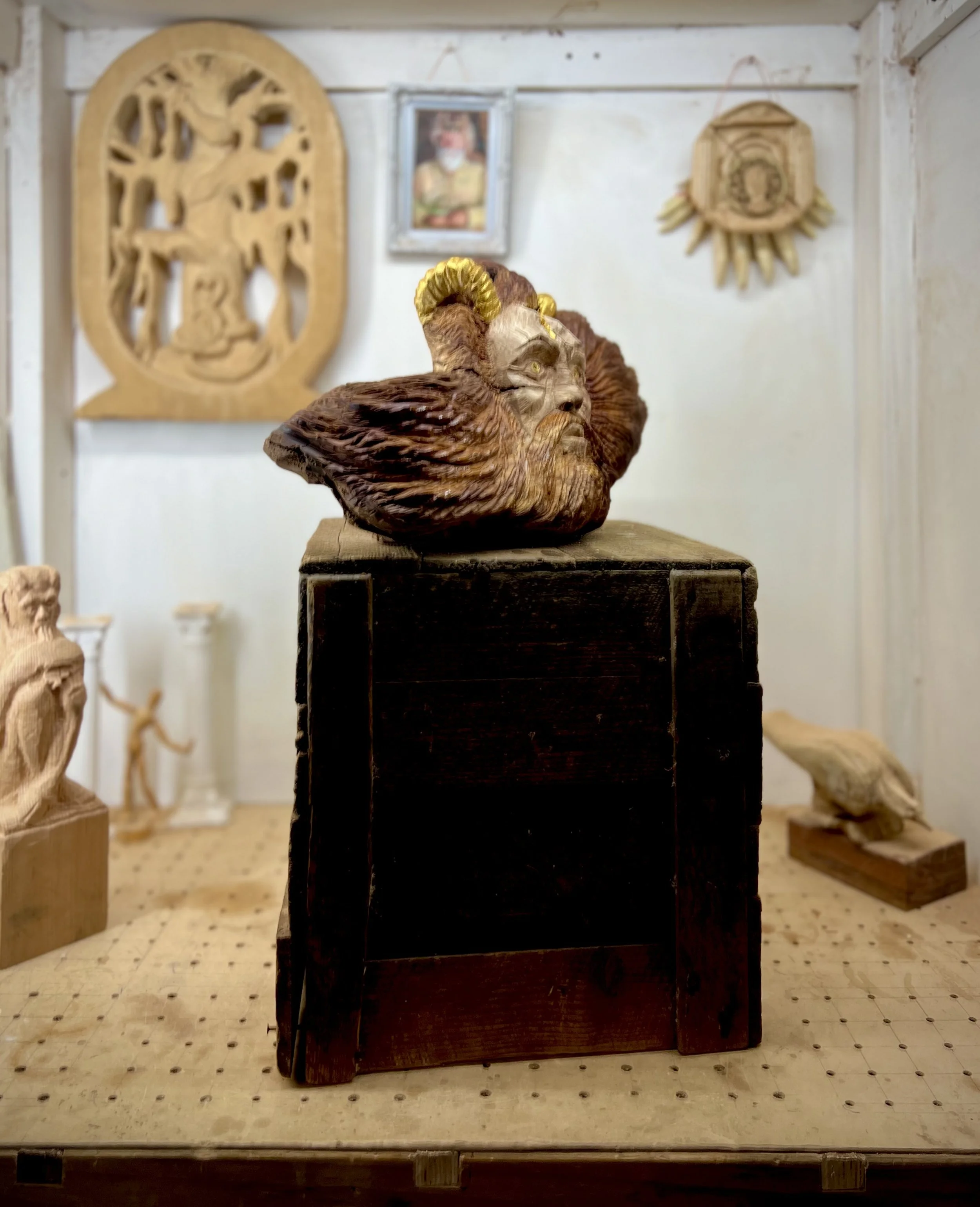
‘The Wild Man”
From the Artists’ Woodshed Studio Retreat
A work, started in 2024, revisited in 2025, and again in 2026.
On grief, the wild man, and the unfinished work of becoming
Before I carve, I have to clean. As I enter the woodshed, I sweep away the sawdust, wood shavings, and mess from any previous work that may have been missed. I put tools back in their ‘homes’ and move the materials, the wood, the stone, the partially finished carvings, until… until things begin to feel right.
Iowa musician Greg Brown once wrote, ‘Lord, I have made you a place in my heart, among the rags and the bones and the dirt….’ And this is, I think, partly what I am doing… making a place in the studio, and in my heart, my mind, my soul for the muse to arrive and bless my creations.
Sometimes a previous work catches my eye. Something I started months, or even years ago. Something I’ve put aside, perhaps because I had reached the limits of what I knew how to do with it.
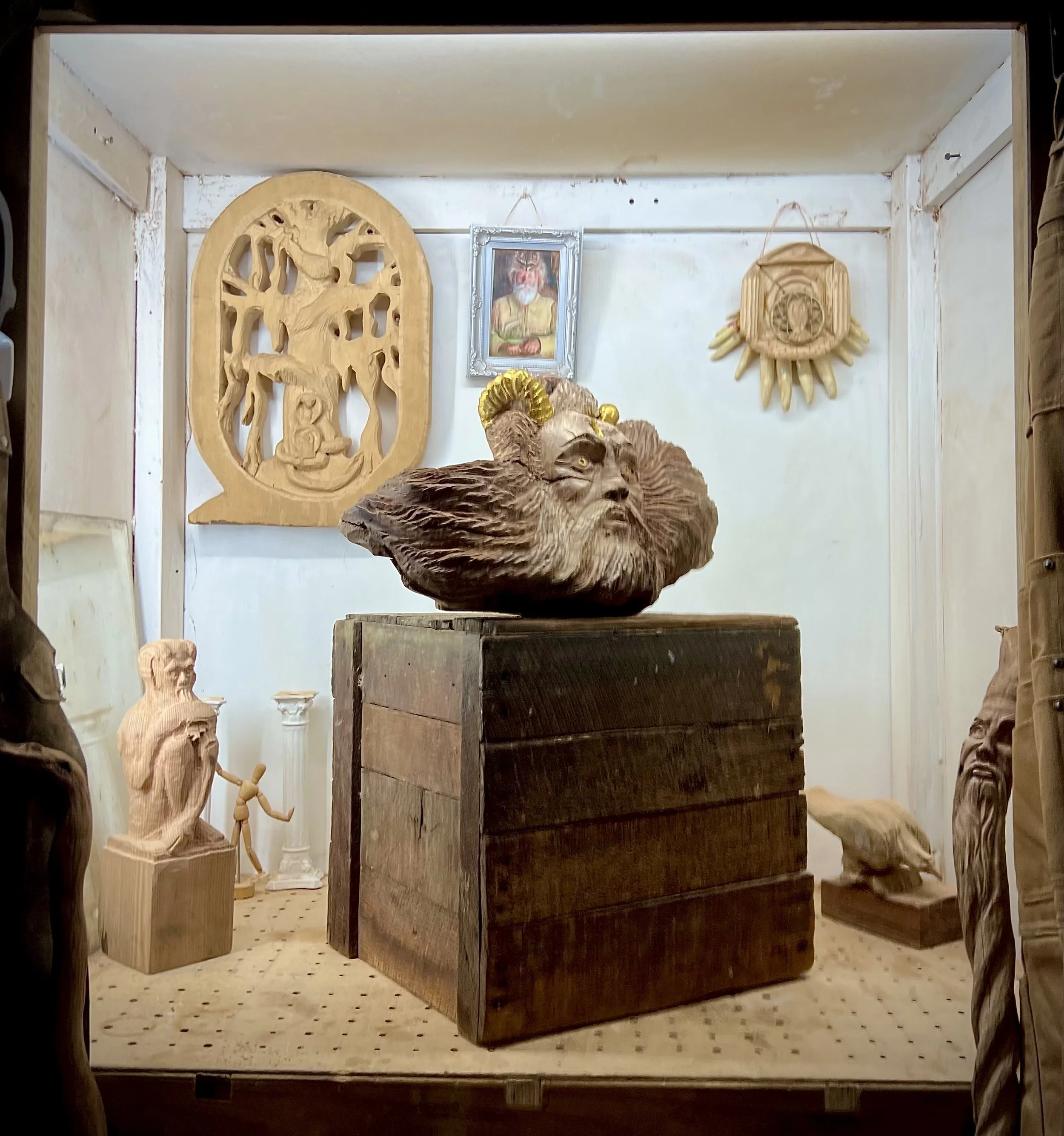
But lately, I’ve found myself returning to one particular carving. The face of a man, emerging from a rough tree stump. His hair rises, and sweeps around him, born from the roots reaching through the earth, or long hair being drawn through moving water. There is something wild about him. Something ancient, perhaps. I see something of Pan, something of the Wild Man, from Iron John, and perhaps, something of myself.
I began carving him in 2024. The wood was given to me by a neighbour. The roots curved and twisted in a way that reminded me of wild hair, and the suggestion of horns. I could see a face within it, although I wasn’t entirely sure how I might bring it into being.
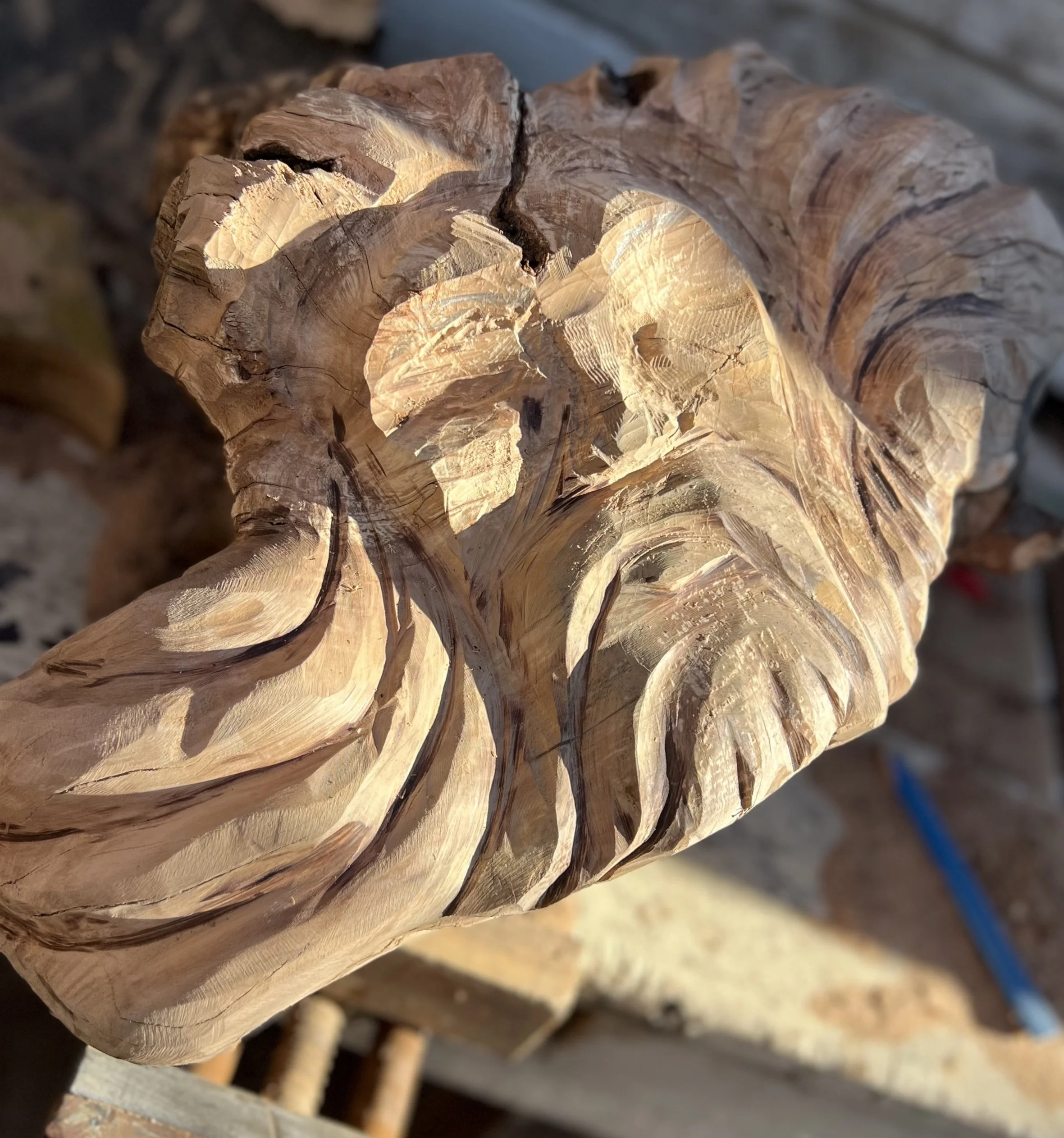
“Iron John"
May 2024
Over time, I’ve returned to him. A year later, and again now, another year after that, I see more in him. My ability to carve has improved, and I understand form and proportion a little better. I can see how the shape of a cheek, the depth of an eye, or the angle of the jaw changes the way we encounter a face. What once seemed almost two-dimensional has begun to take on depth and character.
We are all, I suspect, unfinished versions of the people we might become. We work with the understanding and capabilities we have at the time, and sometimes, if we are fortunate, we have an opportunity to return to something with a little more experience, a clearer eye, and a steadier hand.
I’ve been thinking about this a great deal lately. Because, lately, I’ve also been grieving.
Not simply the loss of someone or something tangible, but the loss of a certain innocence. Some of the assumptions I’ve carried about the world, and about people within it, have been challenged in ways I’ve found difficult. There are things I once believed, or hoped to be true, that I can no longer hold in quite the same way.
And there is grief in that.
A longing, sometimes, for a version of the world that I now understand differently. For an earlier version of myself who could inhabit it with greater ease. I’m still trying to understand what all this means. What I have lost, what I must accept, and what I might carry forward.
Perhaps, that is part of why I have returned to the woodshed this past weekend.
When I carve, my attention becomes absorbed in the wood. I study its grain, its resistance, the way the light falls on a newly shaped surface. My hands become occupied with something immediate, while other parts of my mind seem free to wander.
Sometimes, I become conscious of how much grief I am carrying. Sometimes I lose myself in the work. And sometimes, as I shape the wood, I find that my understanding of something else begins to shift.
The people and stories we return to
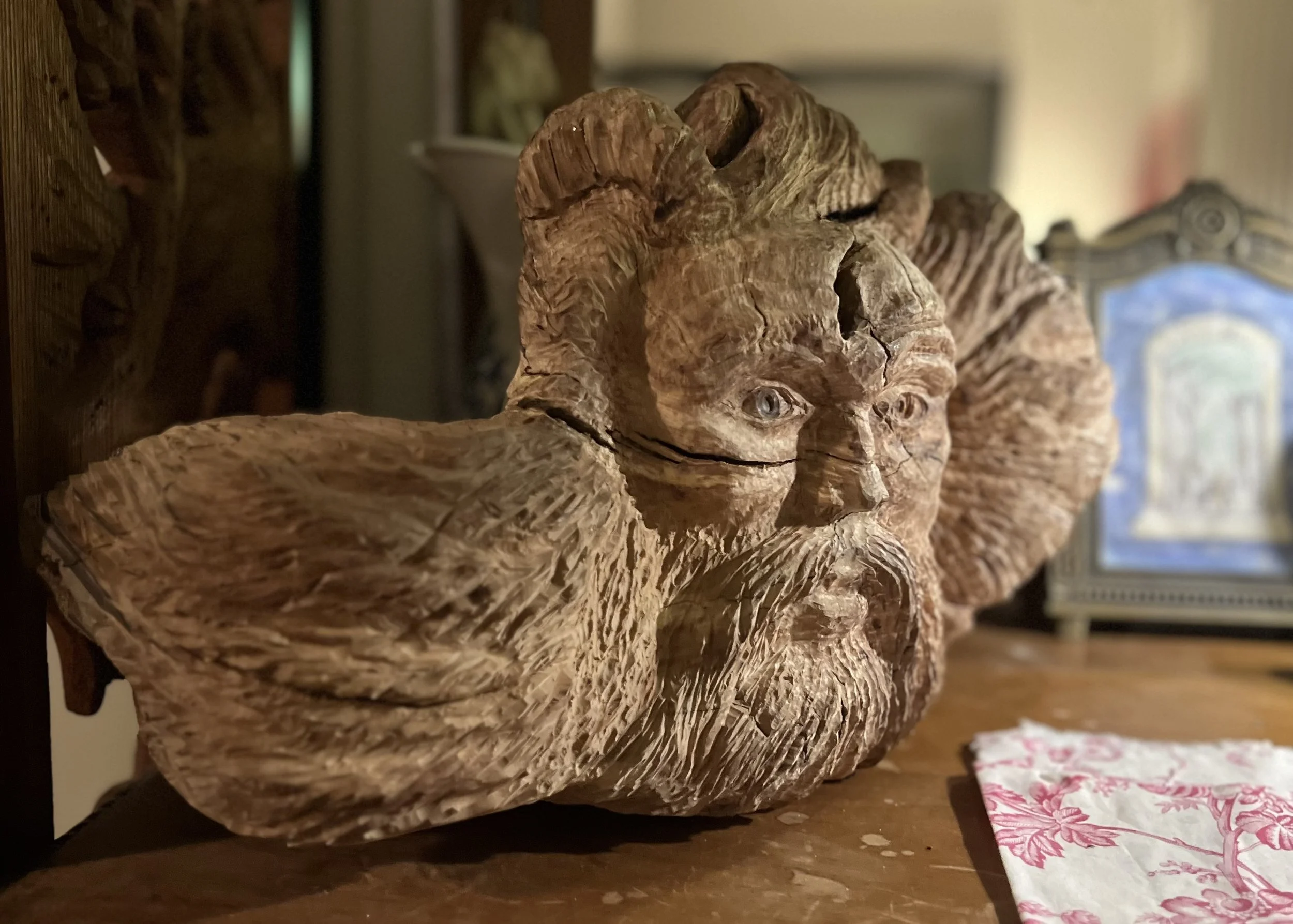
“Iron John - Pan”
August 2024
When I find myself uncertain about life, I often turn toward the people, books, stories, and works of art that have helped shape me. Some have been companions since childhood.
In Kenneth Grahame’s The Wind in the Willows, there is a remarkable chapter, The Piper at the Gates of Dawn, in which Rat and Mole paddle, through the night, looking for a lost otter child, in the silver moonlight, and as the light of the moon fades within the breaking of day, they both lament at the loss of the magic of the moment, wherein they again hear the pipes playing, and encounter Pan, the mysterious god of the wild.
“Trembling...he raised his humble head; and then, in that utter clearness of the imminent dawn, while Nature, flushed with fulness of incredible colour, seemed to hold her breath for the vent, he looked in the very eyes of the Friend and Helper; saw the backward sweep of the curved horns, flaming in the glowing daylight, saw the stern, hooked nose, between the kindly eyes that were looking down on them humorously, while the beaded mouth broke into a half-smile at the corners; saw the rippling muscles on the arm that lay across the board chest, the long supple hand still holding the pan-pipes only just fallen away from the parted lips; saw the splendid curves of the shaggy limbs disposed in majestic ease on the sward; saw, last of all, nestling between his very hooves, sleeping soundly in entire peace and contentment, the little round, podgy, childish form of the baby otter.”
‘Inspiration’
The Artist’s Woodshed Studio Retreat
I think I’ve carried something of that image with me ever since. Pan is a figure of immense power and mystery, yet in Grahame’s telling, he’s also profoundly tender, watching over the lost otter pup, and I think I’ve always found that reassuring. The idea that the wild is both awe-inspiring, and protective.
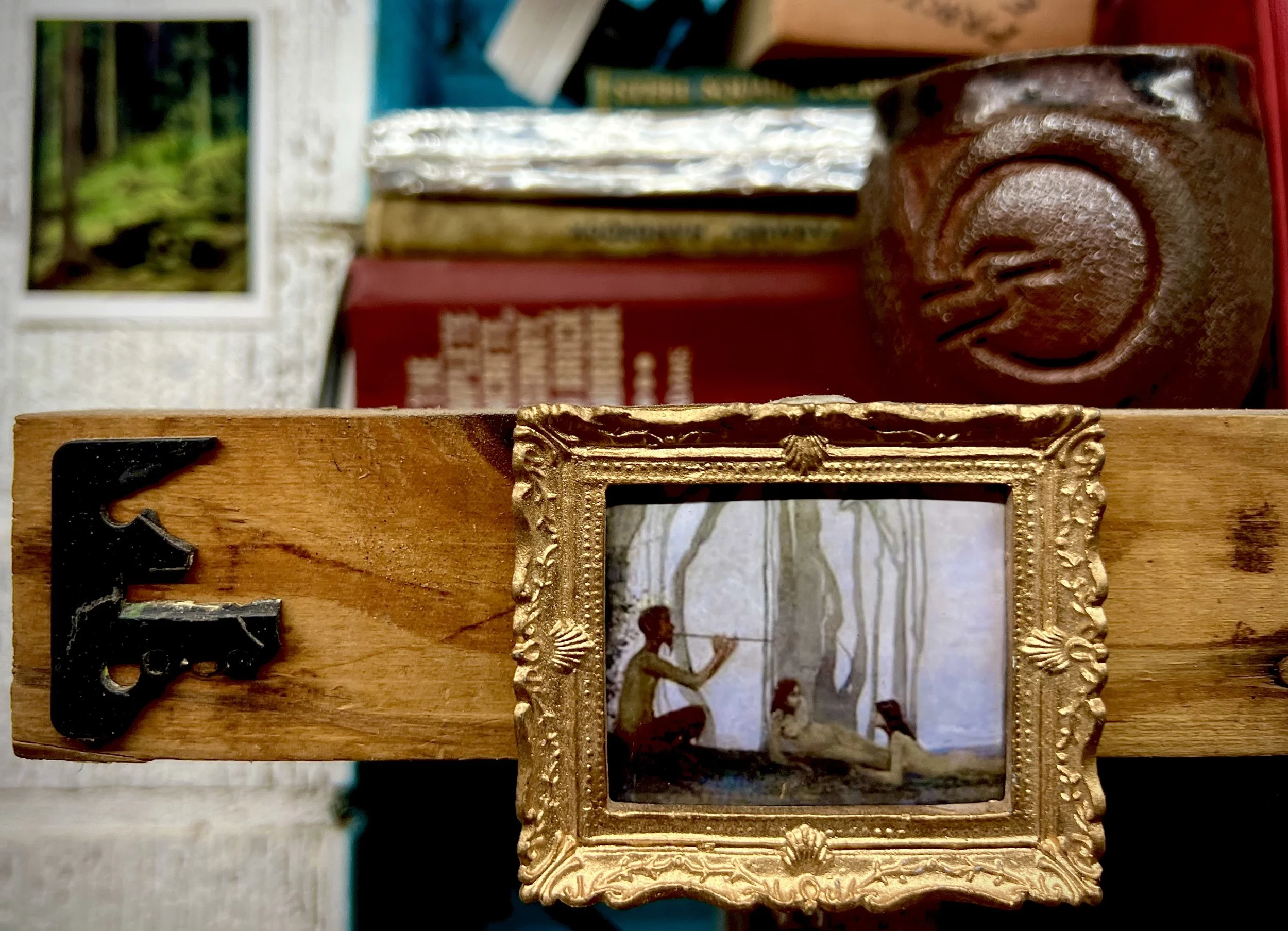
And as I’ve grown, i’ve found a related fascination in the work of Australian artist Sydney Long, whose painting Pan places the ancient mythological figure within an Australian landscape. His flowing, organic forms seem to express something about the vitality of nature, and the creative energies that move through it.
I have a tiny reproduction of one of Long’s paintings in my woodshed, set within a miniature frame intended for a dolls’ house. It sits near my woodworking books and other small objects that have accumulated meaning for me.
I like having these things around me. They remind me that our creative lives are rarely entirely our own. We inherit images, stories, questions, and ways of seeing from those who came before us. Sometimes they remain with us for decades, quietly influencing what we notice and what we make.
Another such influence was the American poet, Robert Bly.
Bly was a mentor to me, and someone whose understanding of mythology, poetry, and the development of men had a profound influence on my life.
His book Iron John draws upon an old Brothers Grimm fairy tale, in which a Wild Man becomes an important figure in a boy’s journey toward maturity. For Bly, the Wild Man represented somethign that could be lost through our efforts to become acceptable, management, and civilised. A connection with instinct, vitality, emotional depth, and the courage to live from somewhere deeper than the expectations of others.
“Mentorship of the Whole of Man”
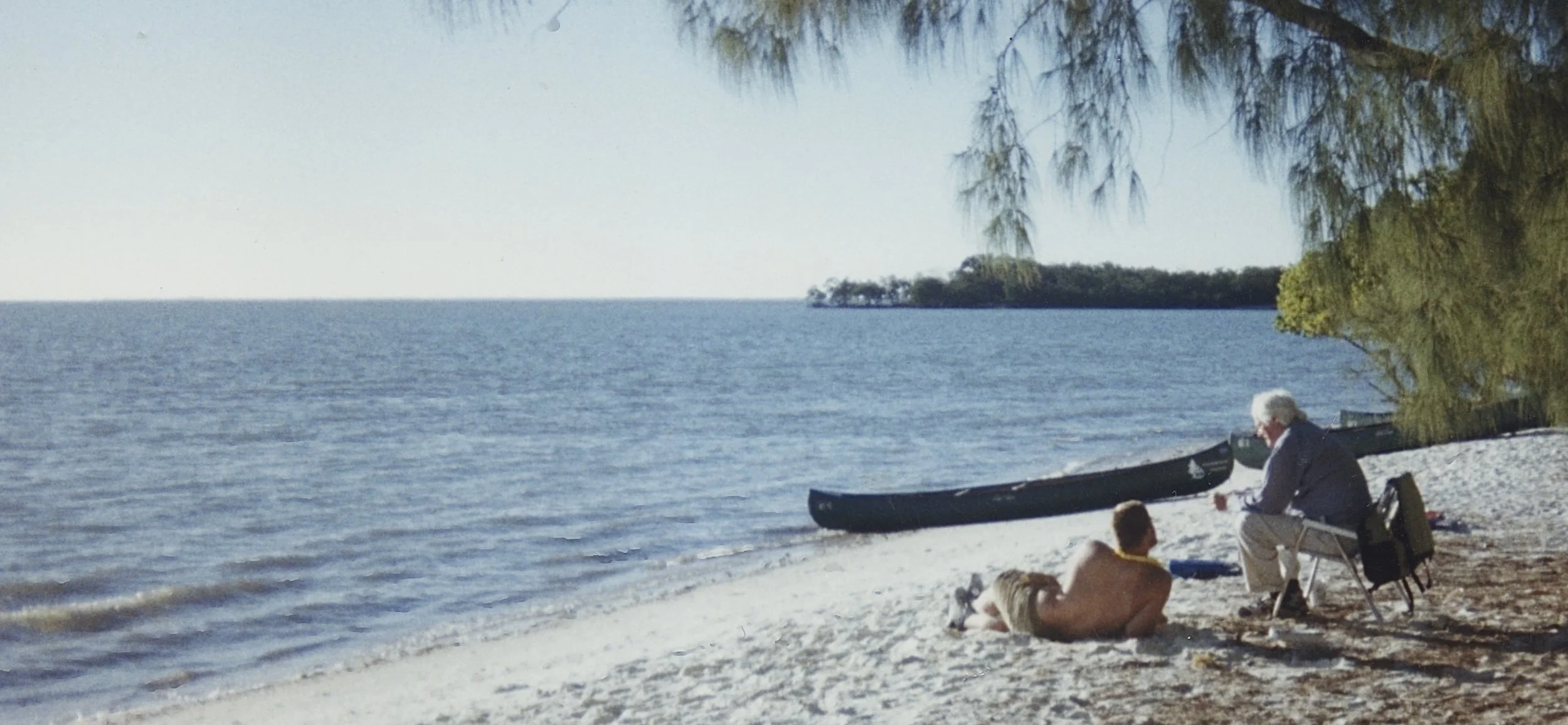
White Horse Key (Gulf of Mexico off the coast of Florida)
Robert Bly and James Samana
I’ve returned to these ideas at different stages of my life, and they have meant different things to me as I’ve grown older. There was a time when I was particularly interested in the question of what it meant to become a man. Now, I find myself increasingly interested in what it means to remain fully human, while living with the responsibilities, disappointments, loves, and losses that accumulate over a lifetime.
Perhaps these are not entirely different questions.
I once spent a week in a canoe with Bly. We talked about love, life, and the long journey of becoming the person we might become. I was not yet a parent, but he spoke to me about parenthood, and the ways our lives change as we take on responsibility for others.
And… he recited poetry. So much poetry. There is a particular kind of generosity in someone offering you a poem at just the right moment. As though they are sharing a small lantern, something you can carry with you long after the conversation has ended.
I remember Bly reciting a poem by Juan Ramon Jimenez, translated into English by Bly himself, called Oceans:
“I have a feeling that my boat has struck,
down there, in the depths,
against a great thing.
And nothing happens!
Nothing… Silence… Waves…
-nothing happens?
Or has everything happened,
and are we standing now,
quietly, in the new life?”
That poem has stayed with me. I think there are moments in our lives when we encounter something so profound that our understanding of ourselves or the world changes. Yet the outward appearance of life remains almost exactly as it was.
There are still meals to prepare, commitments to honour, work to be done, and people who need us.
We continue with the ordinary business of living, while somewhere beneath the surface we are trying to understand an entirely new reality.
I sometimes think this is what grief can feel like. We are standing in a new life, although parts of us are still trying to find our way back to the old one.
On that canoe journey with Robert Bly, I told him about my solo walk of over 5,000 kms across America. And he remembered another poem by Ranier Maria Rilke, which he had translated, about a man who rises from supper, and simply keeps walking, drawn toward something distant that calls to him.
And how another man remains in his house, and how, Bly said, Rilke is asking us to consider what that choice means for the generations that follow.
I’ve thought of that poem many times since then. About the things that call us forward. About the costs of answering, and the costs of remaining where we are. And about the strange truth that becoming something new often involves saying goodby to someone we have been.
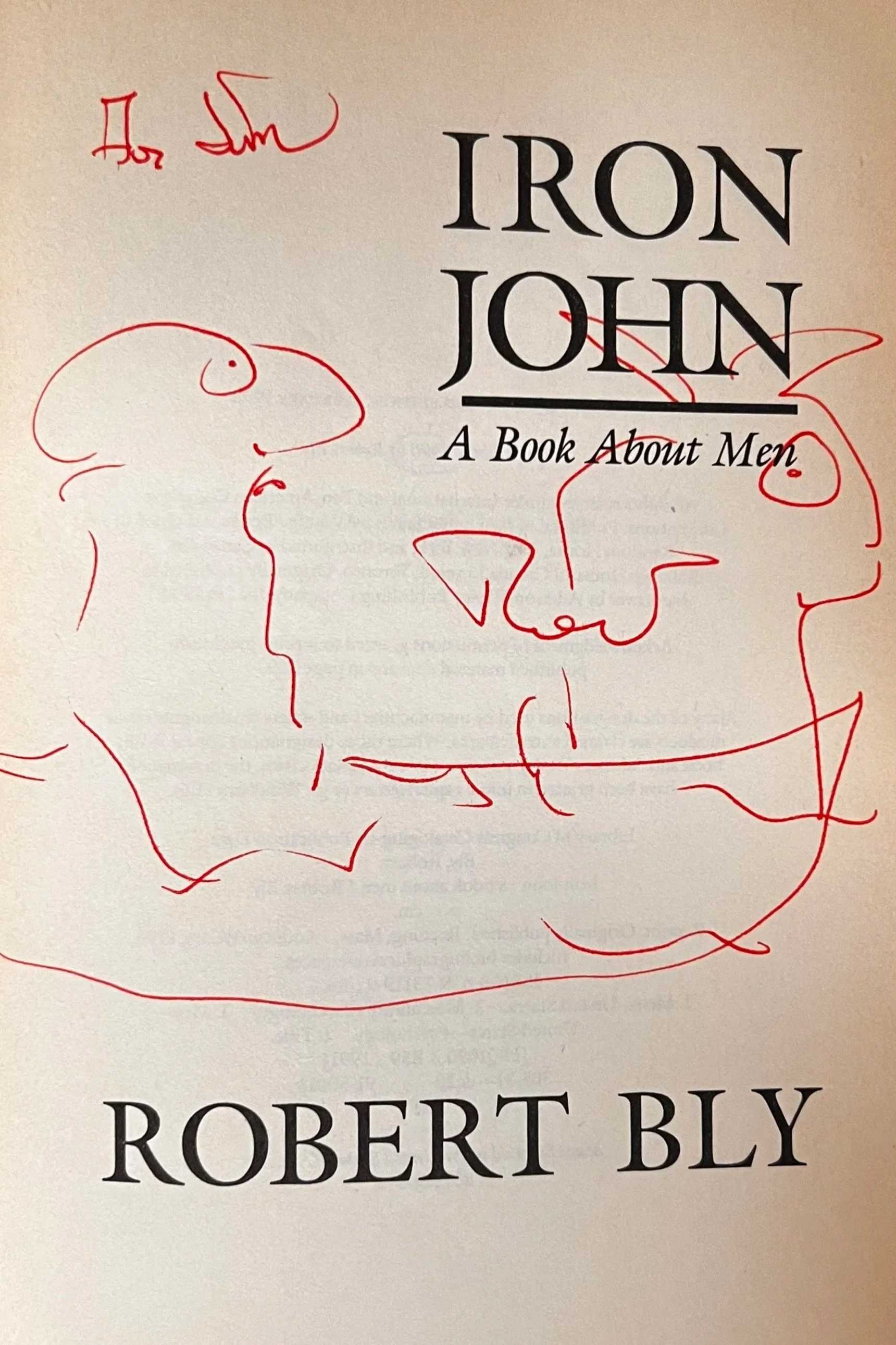
Bly made a little drawing of the two of us in a canoe in my copy of Iron John.
I treasure it.
It reminds me of the conversation, but also of the importance of people who help us find language for experiences we have not yet fully understood.
Now, years later, I find myself returning to his words, and to the Wild Man.
Only this time, I am encountering him in a tree stump, in my own woodshed.
What the wood allows
The material of my carving has some substantial cracks running through it. They were there when I began carving, and they have become increasingly significant to me as the work has developed. There are things I might have done differently with a ‘perfect’ piece of wood. A particular detail I might have carved. A shape I might have attempted. Or a direction I might have taken… but this is the piece of wood that I have.
The cracks run where they run. The grain behaves as it does. Some parts yield easily beneath the chisel, while others resist. And the more I work with it, the more I realise that the wood itself is helping determine what the sculpture can become.
And there’s a kind of partnership in this. The craft requires me to develop my skills, to pay attention, to make decisions, and sometimes to remove something I had previously worked hard to create.
But it also asks me to recognise what is already there. And I wonder whether this has something to teach me about my own life. I cannot return to my younger self, knowing what I know now. I cannot recover every certainty that experience has disturbed. I cannot reclaim every lost possibility, or make every difficult memory disappear.
I can, however, return to the unfinished work of my own becoming.
Perhaps with greater understanding. Perhaps with more compassion. Perhaps with a clearer appreciation of what matters. The work is different now, because I am different.
‘The Golden Wound”
From the Wild Man
The Artists’ Woodshed Studio Retreat
Where the gold resides
In Iron John, there is a moment in the story when the boy places his wounded finger into an enchanted spring, and it turns to gold. Later his hair becomes golden too. There is something extraordinary about that image. The wound, the water, and the gold have remained with me. And as I worked on my Wild Man, I found myself returning to them.
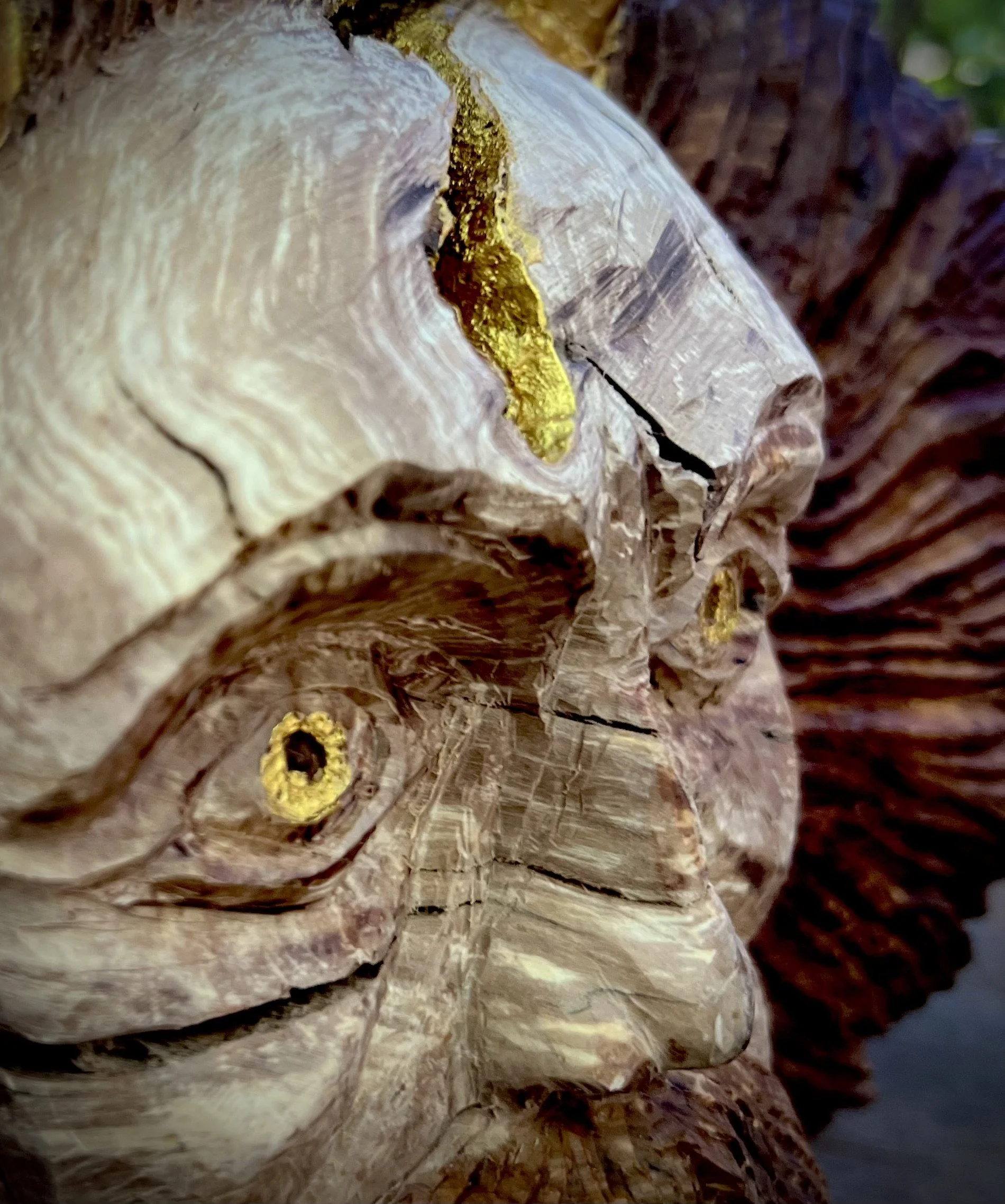
At some point, I decided to paint one of the great fissures in the wood gold.
And I’ve been looking at that scar differently ever since. It has become, for me, a reminder that within the things we grieve there may be clues to what we have most deeply valued.
Some years ago, i wrote an essay titled Behind Every Complaint Is a Commitment. The idea was that when people complain, there is often something beneath their frustration that matters deeply to them. Something they value, something they wish to protect, or something they long to see brought into being.
When we become curious about that commitment, rather than attending only to the complaint, we can begin to understand ourselves and others more compassionately. And we may discover that we have more agency than we realised.
Instead of waiting for someone else to recognise what matters and take responsibility for it, we can begin asking what we ourselves might do to bring that value into the world. I’ve begun to wonder whether grief can offer us a similar insight.
What is it I am mourning?
What did it represent to me?
What was so precious about it that its loss has left such a mark?
Perhaps somewhere within those questions, there is gold.
Not necessarily in the loss itself, but in the recognition of the love, hope , commitment, or sense of meaning that makes the loss so profound. And once recognised, perhaps those values can find expression again, in a different form.
I think of people who are grieving the health they once enjoyed, the energy and possibilities of youth, the loss of a relationship, or a version of their life that will no longer come to pass. There can be real sorrow in recognising that we will never again be precisely who we were.
I feel some of that myself.
And increasingly, I think there is an important distinction between acceptance and acquiescence. Acceptance asks us to acknowledge what has happened, and what is now true. It allows us to begin responding to the life that is before us.
Acquiescence can leave us bitter, longing for a reality that is no longer available, surrendering our agency while remaining inwardly at war with what has happened.
Acceptance does not arrive simply because we decide it should. Sometimes there is grief that needs to be lived. And sometimes that grief is hard, enduring work.
I cannot say that returning to the woodshed this weekend has made me happy. There have been moments of joy, certainly, and moments of peace. But I remain in the midst of some difficult realisations.
Still, I find meaning in the work.
And perhaps joy, when i comes, grows from our willingness to live fully through what we have lost, to discover what remains precious, and to find way s of bringing those things into the world again.
‘Iron John - Pan - Wild Man of Wisdom’
October 2026
Still unfinished
I look at the Wild Man now, and I can see how much he has changed. His face has more depth. His features are more convincing. The movement of his hari feels closer to what I imagined when I first saw the roots of that old stump.
But I can also see things I would like to improve.
Perhaps I will return to him again next year, with another year’s experience, and see something I cannot yet see today. I rather hope so.
For now, he rests on a wooden box give to me by my friend, Nick. Surrounded by other figures I’ve carved… all of which carry memories of stories, artists, and conversations that have accompanied me through much of my life. And now the Wild Man carries a golden scar. I like to think that we are much the same.
We carry the people who have influenced us, the experiences that have shaped us. The losses we have endured, and the values we are still trying to understand.
We are made, in part, from what has been given to us, and in part from what we choose to make of it. And sometimes, when we return to the unfinished parts of ourselves, we discover that we have developed the ability to see something we could not see before.
There is still wood to carve. And I am still becoming.