A Middle Path Through ASL Reduction:

‘Flexible Work and Capability Retention in the Australian Public Service’
Could Voluntary Part-Time Work Help the APS Retain Capability?
When Australian Public Service agencies need to reduce Average Staffing Level, the available choices can appear relatively limited. Agencies freeze recruitment, leave vacancies unfilled, reduce non-ongoing employment, wait for natural attrition, offer voluntary redundancies, or restructure their workforce.
Each option may reduce staffing expenditure and average staffing level (ASL). Each can also create secondary costs: lost corporate knowledge, capability gaps, recruitment delays, increased pressure on remaining employees, redundancy payments, and eventually another round of hiring when workforce demand rises again.
There may be another option worth testing.
Could agencies invite employees to move voluntarily to part-time employment, initially for a defined period, as part of a deliberate workforce-planning strategy?
This would allow agencies to reduce ASL while retaining more of their people, experience, and institutional knowledge. Employees who want to work fewer hours could use the additional time for caring responsibilities, study, community contribution, creative work, rest, or approved employment and side projects outside the APS.
The idea is administratively possible because ASL is not simply a headcount. The Department of Finance defines ASL as the average number of employees receiving wages or salaries over the financial year, adjusted for casual and part-time staff to show the average full-time equivalent. A person working 0.8 full time equivalent (FTE) therefore contributes approximately 0.8 to average staffing level (ASL) rather than 1.0, subject to the timing and formal reporting methodology used across the financial year.
Source: Department of Finance, Audit of Employment Report
For example, if 100 full-time employees voluntarily moved to 0.8, this would reduce their collective staffing level from approximately 100 ASL to 80 ASL. Salary expenditure associated with their paid hours would also fall. The agency would retain 100 people and most of their collective capacity, although its total employment costs would not necessarily fall by the same proportion.
That is the basic proposition. Its value, risks, and implementation deserve much closer consideration.
ASL reduction is not the same as total cost reduction
Part-time employment reduces salary expenditure in proportion to the agreed hours. It does not remove every cost associated with employing a person. Software licences, security clearances, equipment, accommodation, and some administrative overheads may remain unchanged or reduce only gradually.
The distinction matters because an ASL target, a salary-expenditure target, and a total-cost target are related but different workforce problems. Voluntary part-time arrangements may perform strongly against the first two while producing a smaller reduction in the third.
A credible business case should therefore avoid treating ASL savings as a proxy for total financial savings. The pilot should separately measure changes in ASL, salary expenditure, variable employment costs, fixed or semi-fixed costs, and any additional management or administration required.
An alternative to losing whole people
When an experienced employee leaves, an agency loses more than the hours recorded against their position. It may lose knowledge of previous decisions, relationships with stakeholders, understanding of systems, technical expertise, awareness of institutional risks, and the informal knowledge that enables work to move through an organisation.
Some of this knowledge can be documented or transferred. Much of it resides in experience, judgement, relationships, and organisational memory.
A transition from 1.0 to 0.8 retains most of that capability. It may also keep someone connected to public service who would otherwise pursue full-time employment elsewhere, take a redundancy, or eventually leave because full-time work no longer fits their life.
The APS regularly experiences cycles of workforce expansion and contraction. Contractors are engaged when capability or capacity is scarce. Governments then seek to rebuild internal capability, reduce consultancy expenditure, or increase direct employment. Later fiscal pressures lead to staffing constraints, recruitment freezes, attrition, and workforce reductions.
A more elastic internal workforce would not remove these cycles, but it could moderate their effects. Voluntary fractional employment would add another instrument to workforce planning, between retaining a position at full-time capacity and losing the employee entirely.
Treating part-time employment as workforce design
Part-time work already exists across the APS. In the 2024 APS Employee Census, 13 per cent of respondents reported working part-time. Flexible hours were accessed by 30 per cent, while job sharing remained uncommon at 0.3 per cent. All 103 APS enterprise agreements now contain a common clause covering flexible working arrangements.
Source: Australian Public Service Commission, Flexible work in the APS
The institutional foundations therefore exist. The larger change would be in how part-time employment is understood and used.
Flexible work is frequently considered through an individual lens. An employee has caring responsibilities, a disability, health considerations, study commitments, or another reason for seeking different hours. The employee makes a request, and the manager considers whether the arrangement can be accommodated.
Strategic use of part-time work would introduce an organisational lens. Agencies would examine their workforce and identify functions that could be delivered through fractional roles, job sharing, rostered work, redesigned responsibilities, or different combinations of capability.
David Schmidtchen (Professor of Practice, UNSW Canberra) has described flexible work as a different “packaging of workforce capacity and capability,” requiring organisations to reconsider processes and relationships built around assumptions of full-time employment.
Source: David Schmidtchen, “When we say ‘flexible working’, what do we mean?”
That is the design question at the heart of this proposal. What forms of workforce capacity could the APS retain if it stopped treating the full-time position as the only standard unit around which work is organised?
Some roles will require full-time coverage. Others may be suitable for fractional employment, job sharing, scheduled handovers, team-based work allocation, or redesigned accountabilities. These decisions should be based on the work and its operational requirements, rather than assumptions about the commitment or capability of people who work part-time.
Genuine redesign begins with the purpose and required outcomes of the role. It then specifies responsibilities, decision rights, availability, handovers, inputs, outputs, and interfaces with other work. Beginning with the existing full-time duty list and removing a nominal day is unlikely to be sufficient.
A well-designed part-time role may also create distinctive value. It can give an employee protected focus on a defined problem, solution, input, or output, with fewer of the recurring meetings and day-to-day distractions that accumulate around many full-time positions. In a continuous process, a fractional role can be designed around the quality and substance of a particular contribution.
Voluntariness is fundamental
A reduction from full-time to part-time employment also means a reduction in salary. This will be attractive to some employees and financially impossible for others.
Participation must therefore be genuinely voluntary. Employees should receive sufficient information to make an informed decision, be free to decline without disadvantage, and be protected from subsequently being targeted for redundancy because they expressed interest in a different arrangement.
For a pilot, the employee should have an automatic right to return to their previous working fraction at the end of the agreed period. A three-to-six-month trial could allow the employee and agency to assess the arrangement. They could then agree to continue it, make it permanent, modify it, or return to the original full-time arrangement.
This provides employees with security and gives agencies a defined planning horizon. It also recognises that a flexible-work arrangement needs to be tested in the context of the role, team, and employee’s circumstances.
Union and employee representatives should be involved from the design stage. Their involvement would help establish credible safeguards around voluntariness, workload, career progression, reversibility, and protection from adverse treatment.
The work must genuinely become part-time
One of the greatest risks is that an employee moves to 0.8 salary while remaining responsible for a full-time workload.
Monitoring attendance or recorded hours will not prevent this. Agencies would need to reconsider outputs, deadlines, meeting obligations, stakeholder responsibilities, decision-making authority, and the distribution of work within the team.
A 0.8 arrangement must involve approximately 0.8 of the work. This requires more than removing one day from the calendar. Where a discrete portion of the role cannot be removed, the work may need to be shared, redesigned, automated, deprioritised, or allocated differently.
This requirement has broader value. ASL reductions do not themselves reduce the amount of work government expects an agency to perform. Any responsible workforce reduction should therefore be accompanied by decisions about priorities, processes, service standards, technology, and work that can cease.
Voluntary part-time employment cannot substitute for those decisions. It may, however, create the occasion for agencies to make them more deliberately.
Part-time work also needs cultural legitimacy
Formal job design will not be enough if workplace culture continues to treat part-time employment as a lesser form of participation. Part-time employees can encounter jokes about their availability, assumptions about commitment, exclusion from significant conversations, or pressure to remain accessible outside their agreed hours.
Good employees may also work beyond their paid fraction because they feel guilty about leaving work unfinished or believe they must compensate for being part-time. When this occurs, the organisation receives unpaid labour and the apparent success of the arrangement conceals a design failure.
The pilot should make cultural legitimacy an explicit implementation objective. Leaders would need to affirm that part-time work is a valued way to contribute, model respect for agreed boundaries, and monitor actual hours, inclusion, recognition, and access to meaningful work.
Flexibility asks more of managers
A workforce with consistent employment patterns is easier to administer. A workforce containing different fractions, availability patterns, handovers, and external commitments requires more deliberate planning and coordination.
This additional effort is a genuine barrier. It is also part of the capability being tested. Managers would need to define outcomes clearly, allocate work realistically, maintain continuity, coordinate interfaces, and evaluate contribution without relying on physical presence or standard hours as proxies.
Managerial difficulty is therefore neither a reason to dismiss the proposal nor a cost to ignore. The pilot should provide managers with job-design support, planning tools, peer learning, and scheduled reflection, while measuring the additional effort required.
The additional day belongs to the employee
Employees should not have to demonstrate that their non-APS time produces a direct organisational benefit.
Some may undertake caring responsibilities. Others may study, recover from illness, contribute to their community, develop a creative practice, establish a small business, or simply create a more sustainable working life. Personal and professional renewal are legitimate benefits, particularly where they improve retention and make continued APS employment possible.
Others may want additional paid work. This can help offset the reduction in APS salary and allow people to develop a broader portfolio of employment.
The APS already has a framework for this. Current APSC guidance states that employees are generally able to work outside the APS where the activity does not conflict with their official duties, while recognising that agency policies may require approval before secondary employment begins. Actual and apparent conflicts must be declared, assessed, managed, and recorded.
Source: Australian Public Service Commission, Secondary employment and conflict of interest
Approval should continue to apply to a defined activity, organisation or client group, and period. Relevant safeguards would remain in place around confidential information, intellectual property, procurement relationships, lobbying, official networks, public commentary, and the use of APS status for private advantage.
The cultural question is whether these applications are approached primarily as dangers to avoid or as activities that can often be enabled through proportionate risk management.
Integrity should be assessed contextually
The level of risk created by outside work depends on the circumstances. Relevant considerations include the employee’s seniority, official responsibilities, access to information, connection between the outside activity and their APS duties, public visibility, and the likelihood that the activity will reasonably be associated with the APS.
Justice Edelman’s reasoning in Comcare v Banerji, although concerned with political communication rather than secondary employment, offers a useful illustration of contextual assessment. His Honour considered factors including seniority, connection with official duties, the nature and reach of the communication, its association with the APS, and its likely effect on public trust.
Source: Comcare v Banerji [2019] HCA 23, Edelman J
This is an analogy rather than a legal test for secondary employment. It nevertheless suggests a better approach than treating every outside activity as presenting the same level of risk.
Political activity requires particular care, although APS employees do retain the rights of citizens. APSC guidance recognises that employees may participate in political activities and join or hold office in political parties, provided their conduct remains consistent with their APS obligations.
Source: Australian Public Service Commission, Employees as citizens
The appropriate response is heightened scrutiny where an outside activity could affect actual or perceived impartiality, rather than a universal prohibition detached from the employee’s role and circumstances.
Flexibility, inclusion, and retention
Flexible work is consistently identified as an attraction and retention mechanism. The APSC describes it as contributing to a skilled, engaged, and representative workforce, while Australian government workplace guidance links access to flexibility with productivity, retention, employee wellbeing, and increased participation by women in leadership.
Source: APSC, Flexible work in the APS
Source: Workplace Gender Equality Agency, Flexible work
These benefits should not be assumed to occur automatically. Poorly designed part-time work can produce workload intensification, reduced visibility, career penalties, and exclusion from significant work. Those risks should become explicit measures in any pilot.
The APS would also need to ensure that participation is not confined to senior, financially secure, or professionally networked employees. An initial pilot at APS classifications could test the model among employees who are less likely to have established portfolio careers.
Transition assistance could include career reflection, CV and application support, information about employment options, further study, financial implications, and outside-work approval. Similar support is already provided in other forms during significant workforce transitions.
The purpose would be to expand informed choice. No employee should be expected to replace lost salary through a side project, and no side project should be represented as guaranteed income.
A practical pilot
A credible pilot could begin with APS4–APS6 employees across several job families and operational environments. It should include work with measurable outputs, team-based functions, and roles where continuity can be managed through rosters, handovers, or clear input-and-output boundaries. It should also include different forms of work so the APS can identify where the model is suitable and where it is not.
Participation would be voluntary and initially run for three to six months. Employees would have an automatic right to return to their previous fraction at the end of the pilot. Where both parties agree, the arrangement could continue or become permanent.
Selection, comparison, and action learning
Selection is one of the pilot’s most important design challenges. Employees who volunteer may already have stronger motivation, financial flexibility, supportive managers, or roles suited to fractional work. Outcomes should not automatically be attributed to the employment model itself.
The evaluation should establish a baseline for each participating role and use matched comparison groups where practical. Comparison could consider similar roles, teams, or employees who remain full-time, while recognising that a workplace pilot cannot control every contextual difference.
Implementation should be iterative. Employees, managers, and teams should review each arrangement at agreed intervals, examine what is happening to workload, boundaries, delivery, and relationships, and adjust the job design where evidence shows it is needed. Action learning would make these cycles of experience, reflection, adjustment, and retesting part of the method rather than treating variation as a departure from a fixed plan.
What the pilot should measure
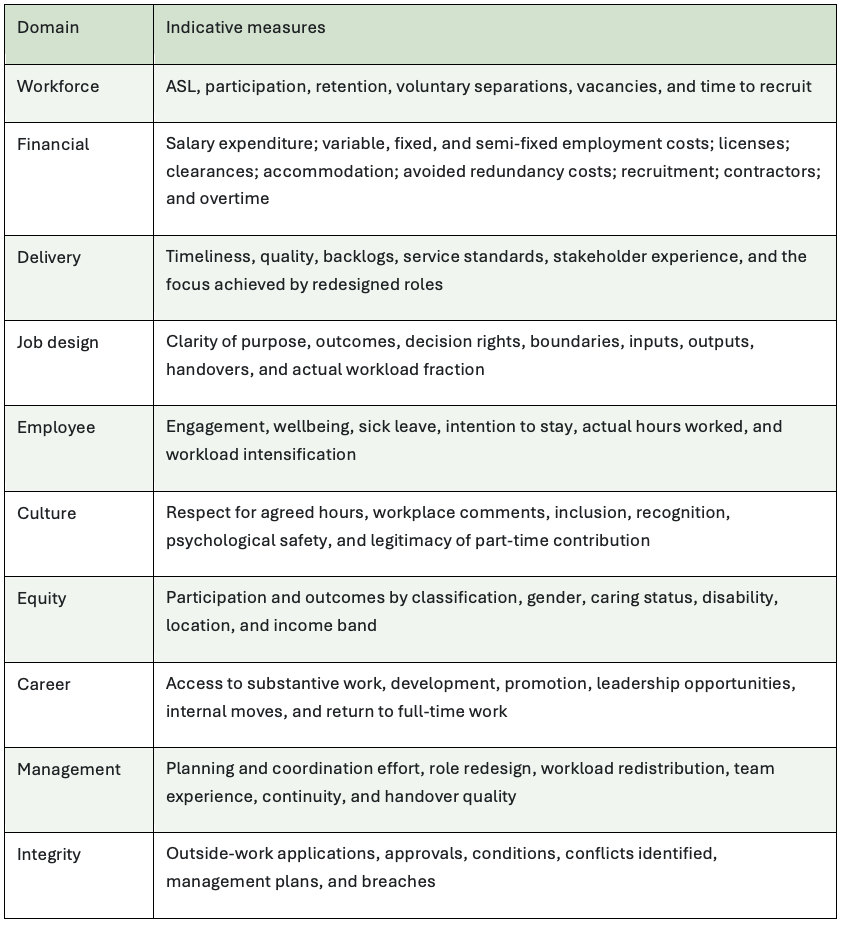
A three-to-six-month employee trial can test whether individual arrangements work. Structured reviews should occur early enough to correct workload or coordination problems, with the overall evaluation continuing for at least 12 months to assess retention, cost, delivery, career, cultural, and management effects.
The proposal should be revised or discontinued if service performance deteriorates materially, employees routinely work unpaid hours, savings are absorbed by contractors or overtime, participation produces inequitable career outcomes, or voluntariness cannot be protected.
An invitation to experiment
The APS needs to manage public resources responsibly. It also needs to retain the capability, memory, and relationships required to serve governments and the Australian community through successive periods of change.
Those responsibilities sometimes pull in different directions. Fiscal pressure encourages reductions, while institutional capability takes years to build and can disappear quickly.
Voluntary part-time employment may offer a middle path. It could reduce ASL and salary expenditure, retain experienced employees, make the APS more accessible to people with different lives and responsibilities, and give agencies greater workforce flexibility. It will not remove every employment cost, and it will require greater management imagination and discipline. Optional outside work could also help some employees sustain the arrangement and maintain a broader professional life, within existing integrity safeguards.
There will be implementation challenges. Jobs must be genuinely redesigned, workloads reduced, boundaries respected, managers supported, conflicts managed, careers protected, and employees given a genuine choice. These requirements define what the experiment must test.
The APS, during ‘the Covid years’, has already demonstrated that long-standing assumptions about where and how public servants work can change. The next workforce-planning question may be whether every role must continue to be organised around one full-time person.
A well-designed pilot would allow the APS to find out.
References
Australian Public Service Commission. Employees as citizens.
Australian Public Service Commission. Flexible work in the APS.
Australian Public Service Commission. Secondary (outside) employment and conflict of interest.
Comcare v Banerji [2019] HCA 23.
Department of Finance. Audit of Employment Report.
Schmidtchen, D. When we say ‘flexible working’, what do we mean?
Workplace Gender Equality Agency. Flexible work.
About the author
James Samana is the founder of Insightful Path. His work spans executive coaching, leadership development, facilitation, workforce and organisational capability, and public-sector practice. He has worked across the Australian Public Service, private sector, academia, not-for-profit organisations, and community settings.
Related Insightful Path analysis
Workforce design is only one part of responsible workforce change. In Workforce Transition: Not Just an Industrial Process—A Leadership Test, I consider the human transition occurring beneath restructures, redeployment and redundancy processes—and why supporting employees through uncertainty is increasingly a matter of leadership, trust and workforce stewardship.