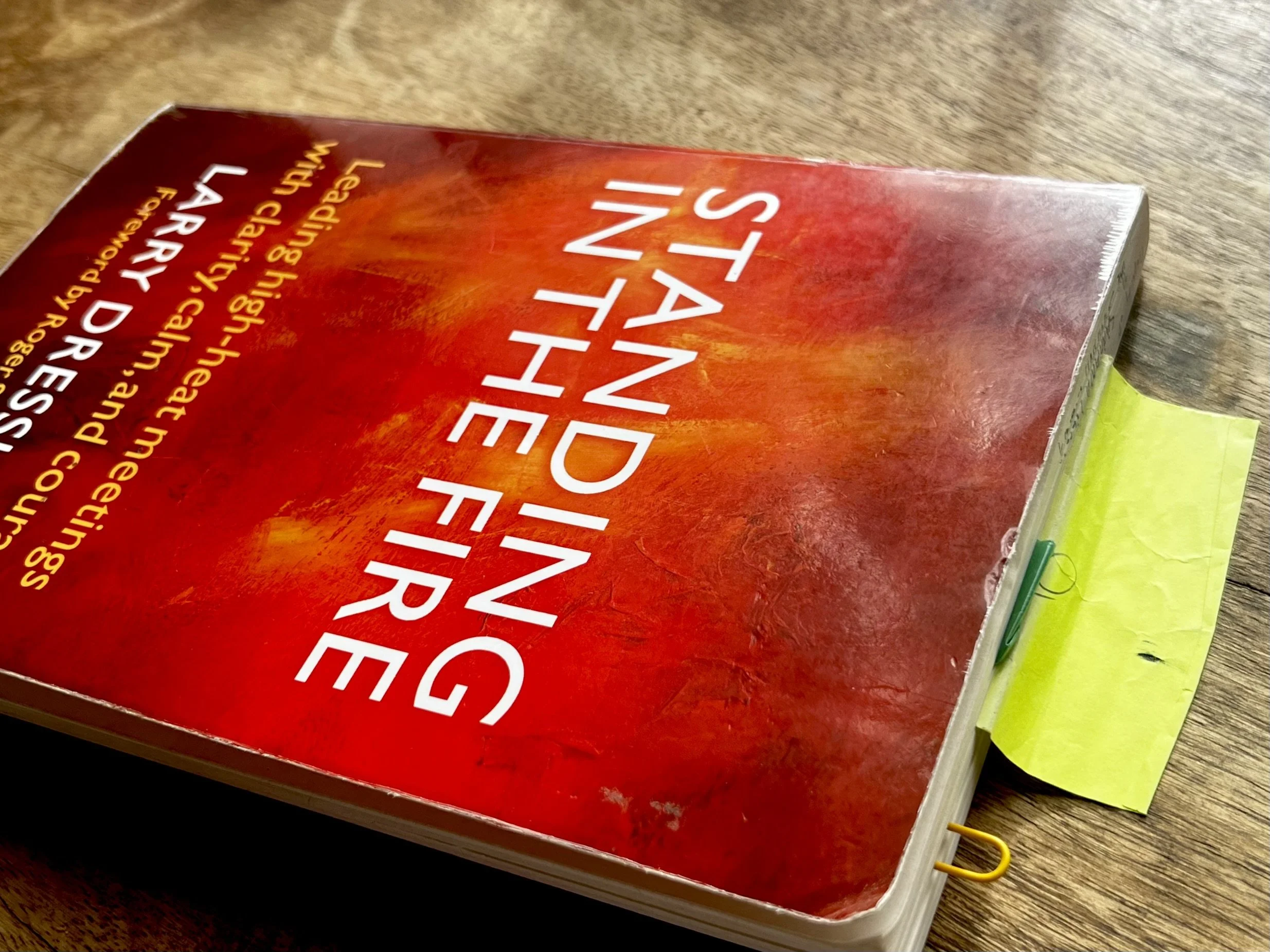
Standing in the fire
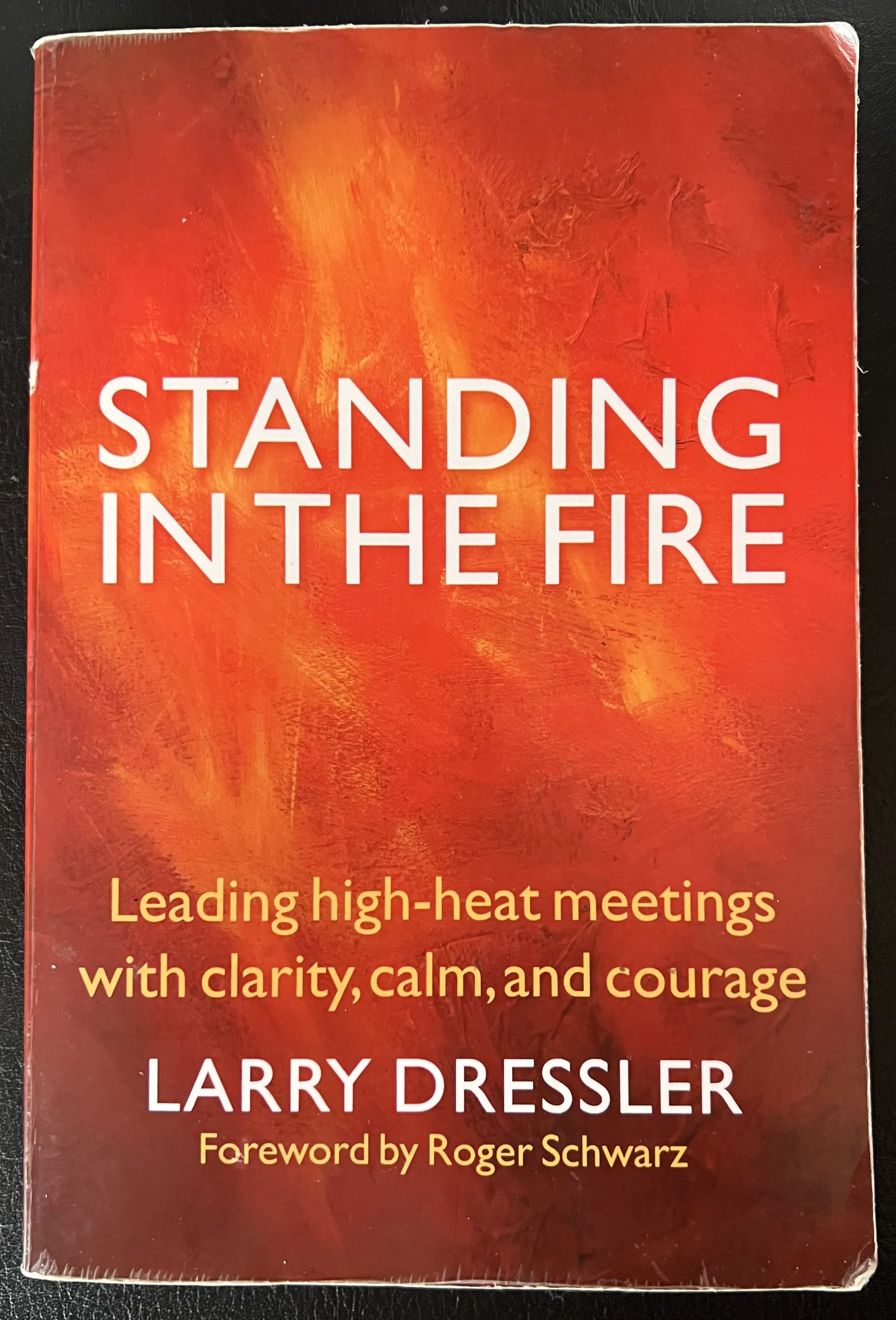
The quiet craft of presence
When the room gets hot
Some of the most important conversations in leadership are also the moments in which our own capacity to lead becomes least reliable. A question lands badly. A long-contained disagreement surfaces. Someone challenges the premise of the meeting, or the authority of the person leading it. Positions harden, emotion enters the room, and the agenda begins to slip.
In those moments, leaders often reach instinctively for control. We simplify the issue, narrow the conversation, offer an answer, move back to the agenda, or try to restore the comfort that existed before the difficulty became visible. The intervention may be skilful. It may even settle the room. But it can also rescue people from the very discomfort through which honesty, learning, and change might have become possible.
Larry Dressler’s Standing in the Fire: Leading High-Heat Meetings with Clarity, Calm, and Courage begins from a more demanding premise. The decisive factor in a difficult room is not simply the quality of our facilitation techniques. It is the quality of the presence from which we use them.
As fire tenders, the most important tool we have is our presence.
This shifts the leadership question. Instead of asking only, “What should I do now?”, Dressler invites us to ask, “Who do I want to be right now?” That question turns our attention from controlling what is happening around us to tending what is happening within us, so that we can remain useful to the people in front of us.
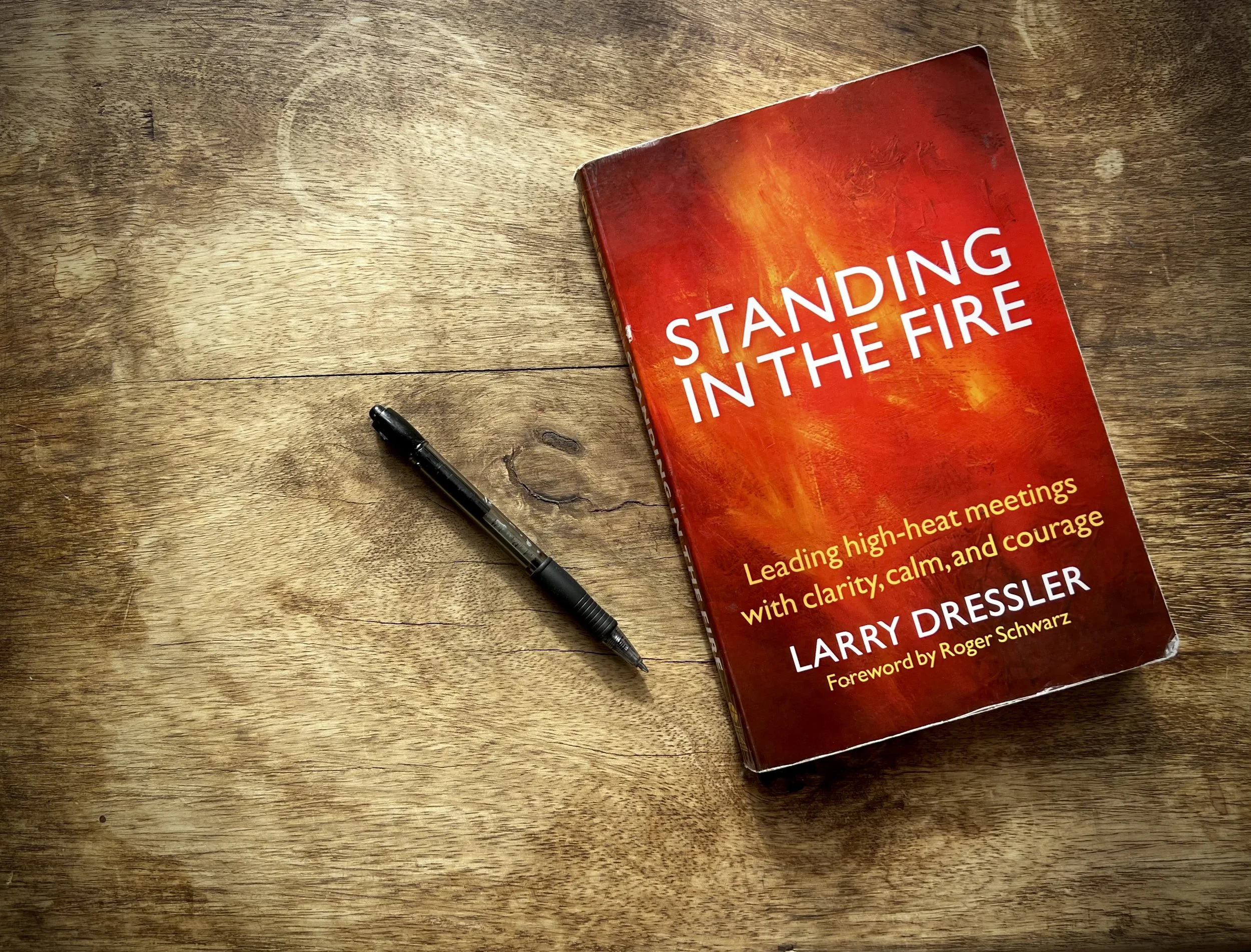
About the Book
Dressler writes for facilitators, leaders, conveners, and anyone responsible for conversations in which conflict, uncertainty, fear, passion, or deeply held convictions are present. He describes these conditions as group fire. Fire can burn, polarise, and overwhelm. It can also illuminate, transform, and make something new possible.
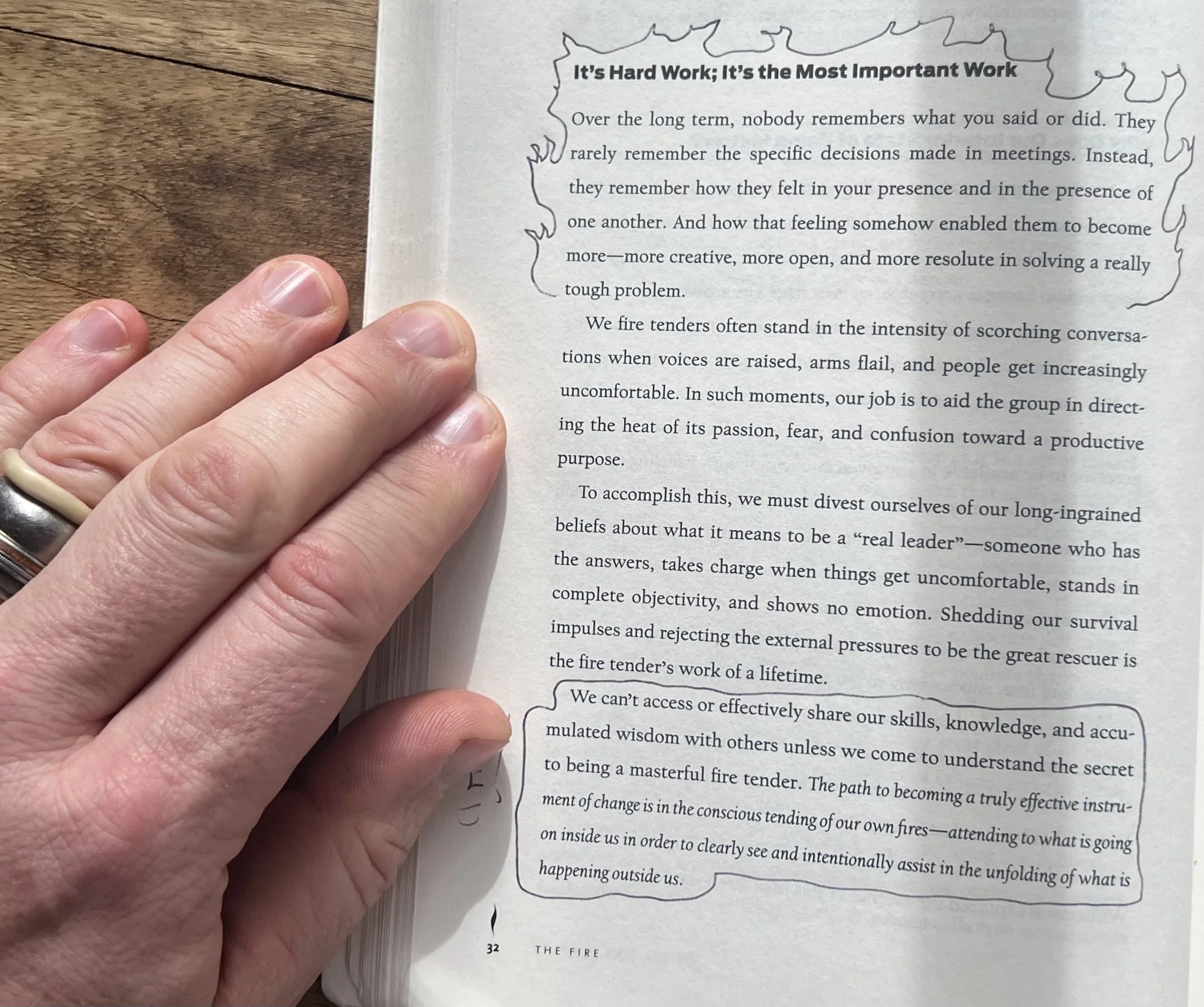
The leader’s task is therefore not to extinguish every sign of heat. Dressler uses the image of the fire tender: someone able to regulate the conditions in which a group can remain with difficult material without being consumed by it. This distinction matters. Discomfort is not always evidence that a meeting is failing. Sometimes it is evidence that something important has finally entered the room.
The book moves through three stages. First, it explores the nature of group fire and the role of the convener. Second, it describes six ways of standing: with self-awareness, in the here and now, with an open mind, grounded in purpose, flexible in the face of surprise, and with compassion. Finally, it offers everyday, pre-meeting, in-the-moment, and reflective practices through which these capacities can be developed.
The structure is practical, but the book’s deeper contribution is developmental. Dressler is less interested in adding another set of interventions to the facilitator’s toolkit than in forming the person who must use that toolkit under pressure.
The Book in One Idea
THE CENTRAL INSIGHT
Our ability to help a group work wisely with what is happening around it depends upon our willingness to work consciously with what is happening within us.
Dressler’s argument is that tools and techniques have limited value when our own thoughts and feelings undermine our ability to use them. The external fire and the internal fire are not separate. We participate in the system we are trying to help, and our ego, anxiety, identity, attachments, and need for control enter the room with us.
That is why presence and mindfulness sit at the centre of my reading of this book. Mindfulness enables us to notice thoughts, emotions, bodily sensations, and impulses without automatically treating them as instructions. Presence is what becomes possible when that awareness allows us to return, again and again, to the people, purpose, and reality of this moment.
Seen this way, standing in the fire is not an act of heroic endurance. It is a discipline of returning.
Key Insights
1. Before we can tend the group’s fire, we must recognise our own
Dressler describes self-awareness as the foundation of wise action. When heat rises, leaders are vulnerable to the same forces affecting everyone else: shame, fear, certainty, defensiveness, and the desire to protect a valued identity. The danger is that we experience an internal reaction and then mistake it for a complete account of external reality.
His discussion of the refractory state is especially useful. Once we are strongly activated, we selectively notice information that confirms and maintains the emotion we are already experiencing. A public criticism can make evidence of support temporarily unavailable to us. A challenging participant can become proof that the whole group is hostile. In such moments, certainty often increases precisely as our perception narrows.
This connects closely with my work in leadership coaching. Leaders carry stories about who they must be: competent, decisive, composed, indispensable, liked or right. When the room threatens that identity, they can begin serving the identity rather than serving the group. Coaching helps make these unconscious stories visible, so a leader can work with them rather than enact them.
Dressler also points to the body as an early-warning system. The tightening chest, warming face, held breath or rising shoulders often appear before we have named the emotion. Mindfulness gives us a chance to notice the signal before the reaction becomes behaviour.
Self-awareness creates a moment of choice: will I follow the energy of self-protection, or create the energy of deliberate action?
Interpretation of Dressler’s central distinction
2. Presence is the discipline of returning
Dressler does not present presence as an uninterrupted state of calm. Standing in the here and now means noticing when regret, anticipation, judgement, or emotional reaction has carried us away, and continuously bringing ourselves back.
This is an important and humane distinction. It releases leaders from the illusion that mastery means never becoming triggered. We will lose our balance. We will form judgements. We will feel the pull of fear, frustration, or the wish to control an outcome. The practice lies in recognising what has happened and finding our way back before those impulses quietly take over the meeting.
Dressler compares the facilitator’s role to that of a midwife. In moments of anger, fear, confusion or loss, our actions may matter less than our capacity to accompany the group without abandoning, rushing or overpowering it. The facilitator does not manufacture the group’s wisdom. Their presence helps create the conditions in which that wisdom can become available again.
This challenges a heroic model of leadership. We do not always need to solve the moment. Sometimes leadership consists of creating enough steadiness for the group to remain with what matters.
3. Curiosity interrupts certainty
Once we are present, another possibility opens: we can encounter what is happening without immediately deciding who is right, who is wrong, or what the moment must mean. Dressler describes the open mind through four capacities: humility, suspended judgement, curiosity, and the ability to hold possibility.
His account of humility is particularly strong: what I see and know is only part of the total picture. This is not a performance of modesty. It is an epistemic discipline, an acknowledgement that our perspective is inevitably partial.
I was struck by Dressler’s practice of bowing as he enters a meeting room. Borrowed from martial arts and spiritual practice, the small gesture reminds him that the room is a place of learning; that participants possess hard-earned expertise and innate wisdom; and that the facilitator enters in service, not as the sole source of intelligence. The bow may be invisible to everyone else, but it changes the person who crosses the threshold.
Curiosity becomes especially important when another person’s ideas repel us. Instead of using our energy to defend an interpretation, we can ask what we have not yet understood. That movement from judgement to curiosity returns the facilitator to purpose and allows them to become what one contributor to the book calls a steward of possibility.
4. We stand steadily by remembering what we stand for
Openness does not mean having no position. In high-heat moments, a guiding intention provides an internal orientation when the external situation becomes unstable. Dressler asks: What am I here to contribute? Who am I here to serve? What is the group seeking to achieve? What is, and is not, my role? What principles will enable me to act with integrity?
Purpose becomes practical when it helps us choose a higher commitment over a habitual reaction. It allows us to say no to our defensive tendencies, no to the illusion of consultation, and sometimes no to an agenda that has become less important than what is emerging in the room.
Purpose also needs compassion. We cannot genuinely serve people while reducing them to the behaviour they display in one difficult moment. Dressler offers a deceptively simple question: “Who else is this person?” The angry executive may also be a worried parent, a dutiful child, an aspiring artist, a person carrying grief or someone afraid of how they are being perceived. We cannot know the whole story. Remembering that there is a story prevents our narrow interpretation from becoming the only one.
Compassion does not require passivity or the abandonment of boundaries. It asks us to respond to a whole human being rather than to the caricature produced by our frustration.
5. Practice forms the presence we later depend upon
The final movement of the book takes these capacities out of the realm of aspiration. We cannot expect to summon presence, curiosity, and compassion on demand if we have not cultivated them outside the crisis. Everyday practice helps us recognise our triggers and limiting patterns. Arriving practice reconnects us with purpose immediately before the meeting. In-the-moment practice helps us return when the heat activates an old response.
Dressler argues that immediately before a meeting, at least half of our attention should be given not to logistics or agenda, but to affirming who we need to be in order to help the group achieve its purpose. This is a deceptively radical rebalancing. Most organisations prepare extensively for what will be discussed and comparatively little for the quality of presence with which the discussion will be led.
PRACTICE INVITATION
Before entering a consequential meeting, pause and ask: What am I here to contribute? Who am I here to serve? What purpose am I helping this group achieve? What principles will allow me to lead with integrity?
Why It Matters Here
From presence to contribution safety
Dressler’s work also illuminates an important connection between mindful leadership and psychological safety. People cannot contribute what a group needs to know if the interpersonal conditions make speaking feel too costly. When leaders become defensive, dismissive, or prematurely certain, participants learn quickly which ideas are welcome, which concerns should remain unspoken, and whose experience carries weight.
Presence does not create psychological safety by itself. Power, systems, prior experience, group norms, and accountability all matter. But the leader’s presence influences the moment-by-moment signals through which people decide whether it is safe to ask, disagree, admit uncertainty, or offer an unfinished thought.
Timothy R. Clark’s language of inclusion and contributor safety adds a useful lens. Inclusion safety asks whether people experience belonging and respect. Contributor safety asks whether they feel trusted to use their skills, experience, and judgement in meaningful ways. Dressler helps us see one of the leadership practices beneath both: the capacity to remain open, curious, and grounded when someone contributes something difficult.
The absence of dissent is not always harmony. Sometimes it is evidence that the room has learned not to speak.
My Reflection
Some books introduce an unfamiliar framework. Others give language to something we have been practicing. Standing in the Fire has done the latter for me.
Across my work in facilitation, executive coaching, leadership development, and mindfulness, I have become increasingly convinced that technique alone cannot carry us through the most difficult rooms. The way we listen, the stories we tell ourselves, the identities we defend, and the quality of attention we bring are not peripheral to the work. They shape the work.
Dressler’s distinction between tending the fire and extinguishing it also resonates deeply. As facilitators, we can become so eager to be helpful that we save people from the learning available within their own stretch zone. Our task is not to remove all discomfort. It is to adjust the metaphorical thermostat, helping the group remain with complexity without allowing the conditions to become destructive or unsafe.
The book also strengthens the link I see between facilitation and coaching. In both, the work often involves making the unconscious visible: noticing the story beneath the reaction, the identity beneath the certainty, or the fear beneath the need to control. Awareness does not solve everything, but it creates the space in which a different choice becomes possible.
The question I will carry from this book is therefore not simply, “How can I manage this meeting more effectively?” It is: “What is this moment revealing about me, and who am I choosing to become within it?”
Where It Holds, and Where I Would Extend It
The book is at its strongest when it integrates inner development with practical facilitation. Its reflection questions and “Try This” exercises repeatedly return ideas to lived experience. It respects the intelligence of the group, treats conflict as potentially generative, and presents presence as disciplined work rather than personality or charisma.
I would nevertheless want to keep several questions alive alongside Dressler’s framework. The facilitator’s inner state matters, but so do power, hierarchy, and structural inequality. Staying with heat can support development, but there are points at which heat becomes aggression, manipulation, or psychological harm. Compassion must coexist with accountability and boundaries. A leader who holds institutional authority also occupies a different position from an independent facilitator and cannot assume impartiality simply because it is sincerely intended.
These are not reasons to reject Dressler’s argument. They are reasons to place it within a wider conversation about power, inclusion, psychological safety, and ethical facilitation. Presence makes better judgement possible; it does not remove the need for judgement.
What to Do With It
The most useful books leave us with practices rather than slogans. Three questions capture the discipline I take from Standing in the Fire:
· Before the meeting: Who am I here to serve, and who do I need to be?
· When the heat rises: What is happening within me, and what am I treating as unquestionably true?
· When another person becomes difficult to hold: Who else is this person?
Together, these questions move through purpose, self-awareness, and compassion. They do not tell us exactly what to do. They help create the inner conditions from which wiser action can emerge.
Why I Recommend This Book
I recommend Standing in the Fire because it reminds us that the most important instrument we bring into a difficult conversation is our presence. That presence requires continuous attention, practice, and care.
Dressler joins three domains that are too often separated: the craft of facilitation, the inner development of the leader, and the collective capacity of groups to work through complexity. He offers neither emotional detachment nor charismatic control as the answer. He asks us to become calm without becoming numb, purposeful without becoming rigid, curious without becoming directionless, and compassionate without abandoning discernment.
I recommend buying the book rather than relying on a summary. Its value lies not only in the six ways of standing, but also in the reflective questions, practical exercises, and repeated invitations to examine your own presence. You can learn more about Larry through Blue Wing Consulting, and purchase Standing in the Fire directly from its publisher, Berrett-Koehler.
Visit Larry Dressler at Blue Wing Consulting | Buy Standing in the Fire from Berrett-Koehler
This book will be especially valuable for leaders, facilitators, coaches, and organisational-development practitioners who have already accumulated a substantial toolkit and are beginning to realise that technique alone cannot carry them through the most difficult rooms. It is also highly relevant to APS leaders working across competing interests, institutional pressure, and conversations in which people need to feel safe enough to contribute what the system needs to hear.
Closing Reflection
When a room becomes heated, we are often tempted to judge our leadership by how quickly we can settle it. Dressler offers another measure: can we remain present enough to help the group encounter what the heat is revealing?
That requires more than composure. It requires awareness of the stories unfolding within us, humility about what we know, curiosity about what we resist, compassion for the people we are tempted to reduce, and clarity about whom we are there to serve.
The fire may be occurring in the room, but the first fire we are responsible for tending is our own.
Who do I want to be right now?
The question at the heart of Standing in the Fire
Continue Your Exploration
Dressler’s ideas become richer when read alongside work on mindful leadership, truthful conversation, and the conditions that allow people to contribute. If this review resonated, these are natural next steps.
Related reviews and insights
The Power of Mindful Leadership: A conversation about slowing down, resilience and what it means to lead with presence.
How to Hear What You Need to Hear: A reflection on the barriers that prevent leaders from receiving difficult information and the conditions that make honest contribution possible.
Radical Candor: On the Discipline of Truthful Care: A companion review on combining courage and compassion in conversations that matter.
Putting the ideas into practice
Executive Coaching: Support for leaders seeking to notice the patterns shaping their presence and create space for more deliberate choices.
Leadership Development: Learning experiences that cultivate mindful, responsible and relational leadership.
Facilitation and Learning Design: Designing and leading conversations in which complexity, difference and contribution can be held constructively.