Radical Candor
On the discipline of Truthful care
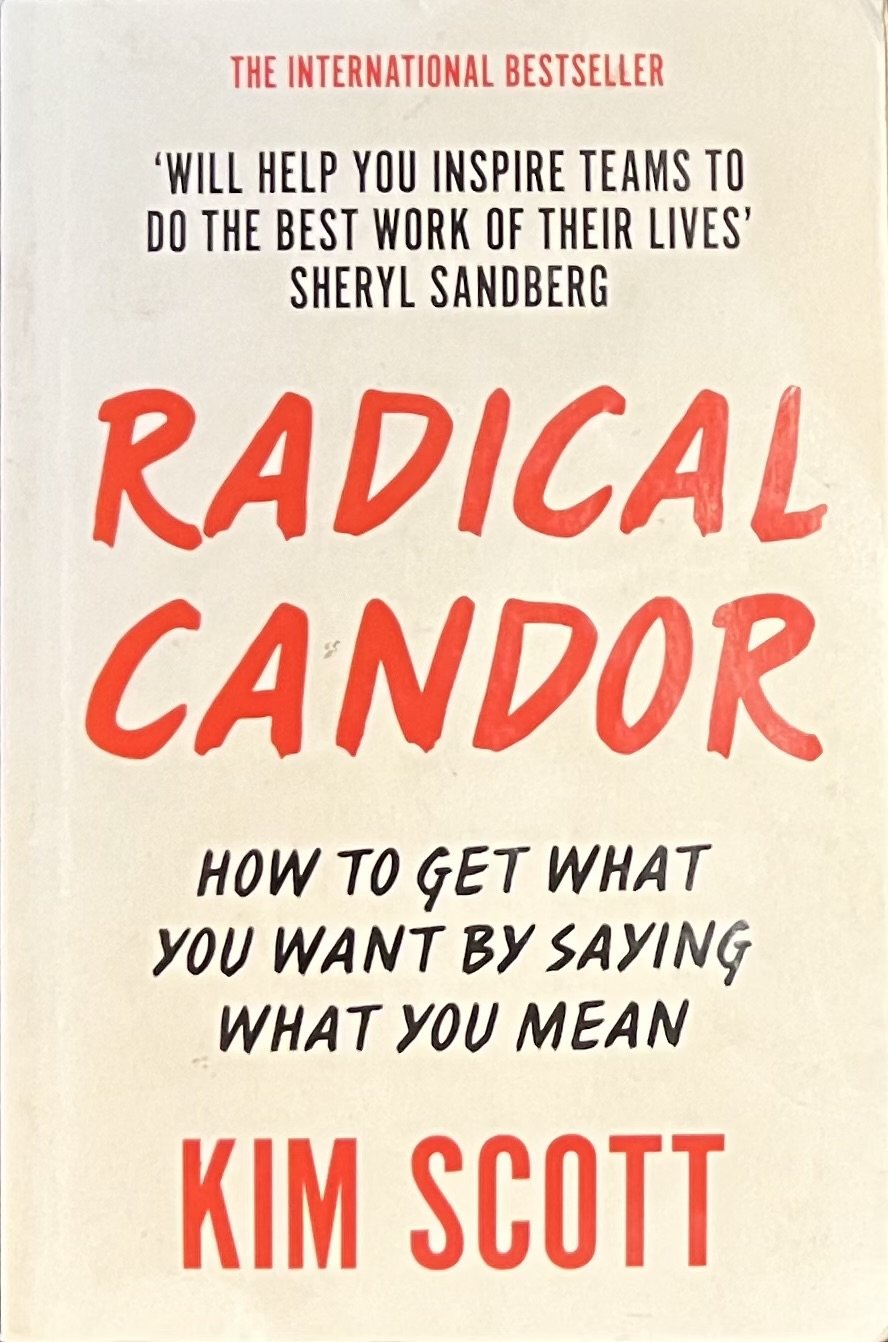
Radical Candor is a management and communication concept introduced by Kim Scott in her book Radical Candor: Be a Kick-Ass Boss Without Losing Your Humanity.
THE LEADERSHIP PROBLEM
Some of the most important leadership conversations are also the ones we are most tempted to avoid. It may be a difficult piece of feedback, a concern about performance, a behaviour quietly undermining trust within a team, or a decision that someone simply does not want to hear. Whatever form it takes, many leaders find themselves caught in an uncomfortable tension. They genuinely care about the person in front of them, yet worry that speaking honestly may damage the relationship. Others resolve the tension in the opposite direction, saying exactly what they think, but doing so without the empathy or respect needed for the message to be heard. In both cases, the opportunity for learning is diminished.
Kim Scott argues that this dilemma is not a choice between kindness and honesty. Rather, effective leadership depends upon bringing the two together. The challenge is not deciding whether to care or whether to challenge, but learning how to do both at the same time.

“an example of why radical candor is needed”
Scott’s own reflections on poor leadership remind us that feedback delivered without care rarely develops people. It usually teaches fear.
THE BOOK IN ONE IDEA
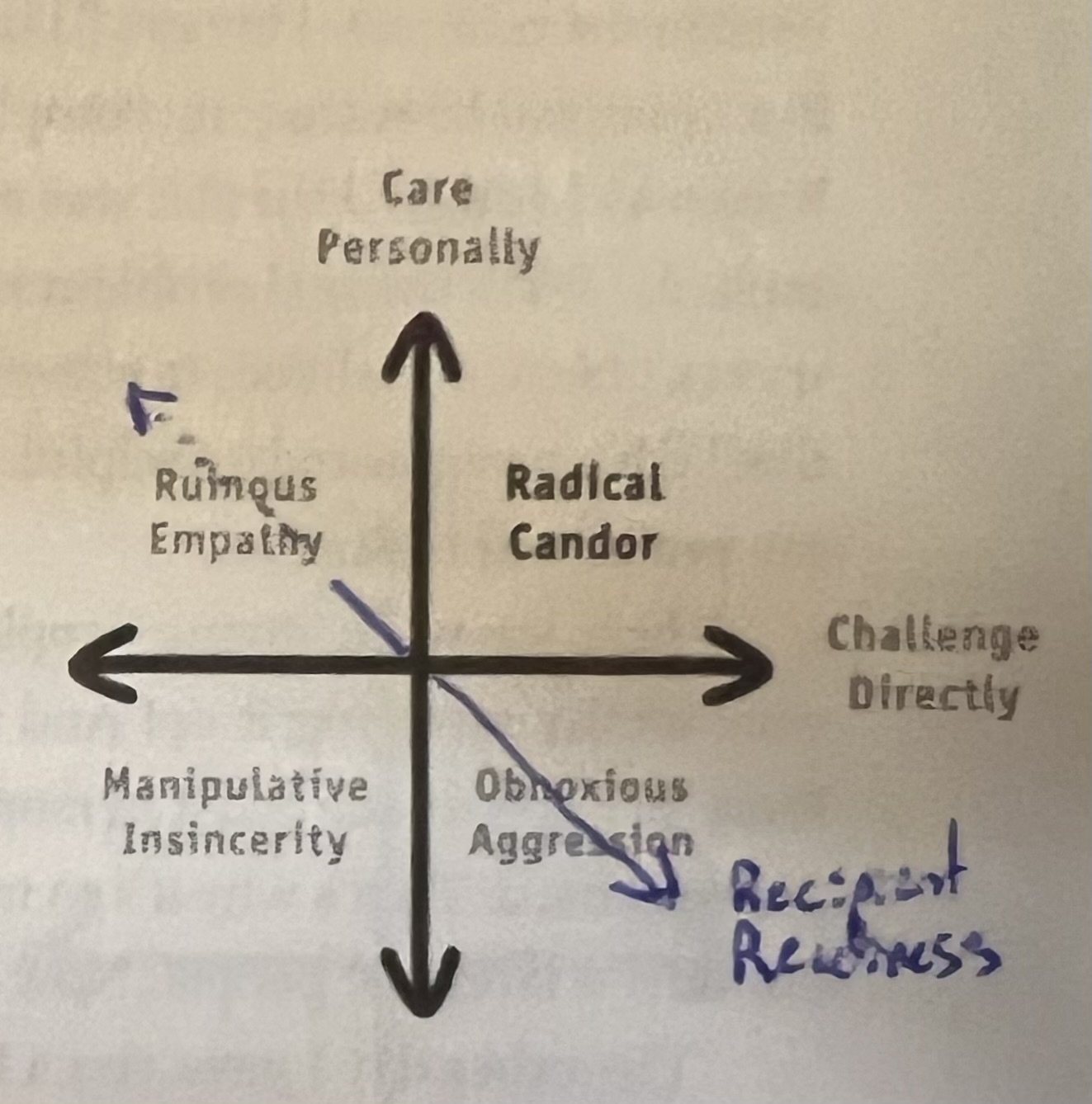
Drawing on her experience coaching executives and leading teams across organisations including Google, Apple, Dropbox, Qualtrics, Twitter, and YouTube, Scott developed what has become known as the Radical Candor framework. At its heart are two deceptively simple questions: Do you care personally? and Are you willing to challenge directly?
The framework suggests that when we care about someone but avoid difficult conversations, our concern slowly becomes what Scott calls Ruinous Empathy. We spare another person temporary discomfort, but also deprive them of an opportunity to grow. At the opposite extreme lies Obnoxious Aggression, where difficult truths are delivered without care, often leaving people feeling diminished rather than developed. Where neither care nor challenge is present, communication becomes Manipulative Insincerity, driven more by self-protection than by a genuine desire to help another person succeed.
Scott's central insight is that honest relationships require both courage and compassion. Truth without care becomes harshness. Care without truth becomes avoidance. It is only when the two are held together that feedback becomes an act of leadership rather than simply an exchange of opinion.
Over time I've found Scott's framework enormously useful. One addition I have made for my own coaching and facilitation practice is a third consideration that sits alongside the original two dimensions: what I call recipient readiness. This reminds me that the effectiveness of honest feedback depends not only upon the courage of the speaker, but also upon the listener's capacity to receive it.
“Speaking truth with care”
WHY IT MATTERS HERE
This idea has influenced my own coaching and facilitation far beyond the context of performance management. Throughout my work I have met leaders who desperately want to support their people, yet unintentionally withhold the very conversations that would help them grow. I have also seen leaders who pride themselves on "telling it like it is", while remaining largely unaware of the damage caused by feedback delivered without relationship, curiosity, or respect.
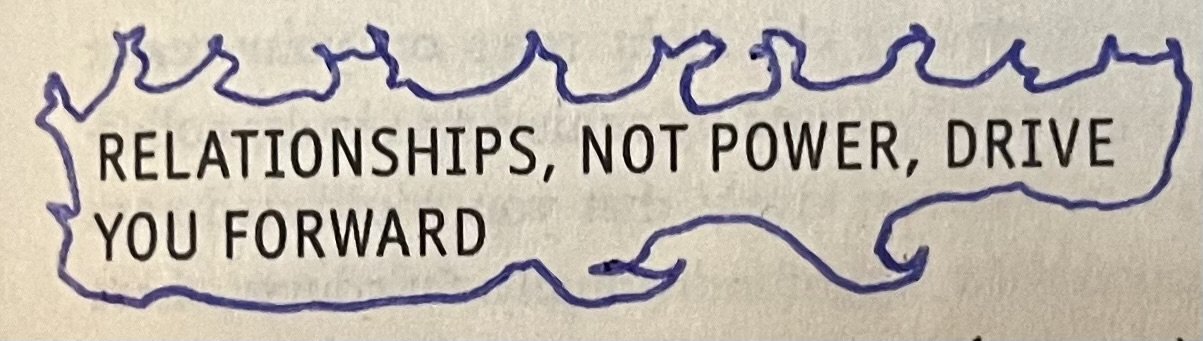
Scott reminds us that leadership is fundamentally relational. The purpose of difficult conversations is not to demonstrate authority, nor to prove ourselves right, but to help another person become more capable than they were before the conversation began. That requires us to hold two commitments simultaneously: a genuine concern for the person, and an equally genuine commitment to their growth.
“A Truth worth remembering”
One of the ideas that remained with me long after I finished the book
WHERE IT HOLDS / WHERE IT DOESN'T
I find Scott's framework both elegant and immediately practical. She is right that organisations suffer when difficult conversations are continually postponed, and equally right that care without challenge eventually becomes neglect disguised as kindness.
Where I would extend her thinking is in recognising that every difficult conversation involves not only the skill of the speaker, but also the readiness of the listener. Over the years I have found it useful to think about what I call recipient readiness. Some people have never experienced direct feedback offered with genuine care. Others may be carrying anxiety, shame, exhaustion, or uncertainty that makes even well-intended feedback difficult to receive.
This does not suggest that we soften the truth or avoid the conversation. Rather, it reminds us that effective leadership is concerned not only with the message itself, but also with creating the conditions in which that message can genuinely be heard. Sometimes the greatest skill lies not in changing what needs to be said, but in preparing the relationship so that the truth has somewhere safe to land.
WHAT TO DO WITH IT
Scott's work offers several practical disciplines that have remained with me. The first is to care enough about people that you are willing to have conversations others might avoid. The second is to distinguish between the worth of the individual and the behaviour that needs to change, ensuring that challenge remains directed toward actions rather than identity. The third is to cultivate cultures where feedback becomes a normal part of learning, rather than something reserved for moments of crisis or formal performance reviews.
When these disciplines become part of an organisation's culture, difficult conversations cease to be exceptional events. They become ordinary expressions of mutual respect, shared learning, and collective responsibility.
WHO SHOULD READ THIS
This is an excellent book for leaders, managers, coaches, facilitators, and anyone responsible for helping other people grow. While it is often presented as a management book, I think its relevance extends much further. Parents, teachers, colleagues, and friends all face moments where they must decide whether to remain silent, speak carelessly, or find the more demanding path of speaking honestly with genuine concern for the other person.
Ultimately, Radical Candor is less about feedback than about the quality of our relationships, and the kind of people we choose to become within them.
CLOSING REFLECTION
What I appreciate most about Scott's work is that it rejects a false choice that appears repeatedly throughout leadership. We are often encouraged to believe that we must either preserve harmony by avoiding difficult truths, or demonstrate strength by saying exactly what we think regardless of the consequences. Scott offers a more demanding alternative. She suggests that mature leadership requires us to care enough to tell the truth, and to tell the truth in a way that reflects our care.
Looking back across my own life, the people who have most influenced my development were rarely those who simply encouraged me, nor those who simply criticised me. They were the people who respected me enough to speak honestly, while making it equally clear that they believed I was capable of becoming more than I presently was. That combination of truth and care is, I think, one of the quiet disciplines of good leadership, and one well worth practising.
CONTINUE YOUR EXPLORATION
Radical Candor is worth returning to because it asks a question that extends well beyond the workplace: How do we speak difficult truths without losing either compassion or courage?Scott reminds us that honest communication is not simply a management technique, but a discipline of relationship. The challenge is not merely learning to give feedback, but becoming the kind of person who can care deeply enough to speak truthfully, and speak truthfully enough to genuinely care. Her ideas become even richer when read alongside other works that explore integrity, courage, and the formation of character.
RELATED BOOKS
No single book captures the whole discipline of honest leadership. Scott explores how care and challenge can coexist within our conversations, but her ideas become richer when read alongside authors who examine integrity, love, courage, and the development of mature judgement.
Self-Reliance – Ralph Waldo Emerson: For readers interested in developing the inner independence required to speak honestly, even when agreement or conformity would be easier.
The Art of Loving – Erich Fromm: For readers interested in understanding care as an active discipline, and why genuine concern for another person's growth is inseparable from honest communication.
Profiles in Courage – John F. Kennedy: For readers interested in the courage required to remain faithful to principle when honesty carries personal or professional cost.
RELATED INSIGHTS
The questions Scott raises continue to influence my own thinking about leadership, coaching, facilitation, and learning. These reflections explore the relationship between honesty, courage, psychological safety, and the conditions that allow people to continue growing.
Understanding Assertiveness: A reflection on remaining compassionate while speaking difficult truths, and why genuine care sometimes requires us to say what would be easier to leave unsaid.
Resistance to Change:A reflection on why people often defend existing beliefs, and how curiosity, trust, and psychological safety create the conditions in which genuine learning and change become possible.
Learning What Cannot Be Taught:A reflection on why growth depends less upon receiving instruction than upon developing the humility required to learn from difficult feedback and experience.
The Strength We Need – A reflection on why mature leadership requires the courage to combine strength with compassion, and how honest relationships depend upon both.
PUTTING THESE IDEAS INTO PRACTICE
Scott reminds us that honest communication is less a technique than a discipline of relationship. Her work continues to influence the way I coach leaders, design learning experiences, and facilitate conversations where trust and accountability must grow together.
Executive Coaching – supporting leaders to hold difficult conversations with clarity, empathy, and respect, strengthening both relationships and performance.
Leadership Development – helping leaders cultivate cultures where honest feedback, psychological safety, and mutual accountability become everyday leadership practices rather than exceptional events.
Facilitation and Learning Design – designing conversations that enable disagreement, reflection, and learning without sacrificing trust, curiosity, or psychological safety.
BEYOND THE BOOK
Scott has continued to refine and expand these ideas through her later writing, public speaking, and interviews. If this review resonated with you, you may also enjoy exploring the following conversations, where in August of 2022 I had the opportunity to talk with her about Radical Candor as well as her next book, Just work: Get it done fast & fair, which was published in 2021.
Inoculate your workplace against bias, prejudice, & bullying – The first of two interviews exploring Radical Candor, Just Work, reducing bias in organisations, and creating cultures where honesty and care can coexist.
Disrupting bias in your work - with Kim Scott– The first of two interviews exploring Radical Candor, Just Work, reducing bias in organisations, and creating cultures where honesty and care can coexist.

For more information about Kim, her work, or to order her books, please check out her website: https://www.radicalcandor.com/our-approach/.