Successful hybrid workshops
Human connection first, always
Hybrid workshops are often treated as a technology problem. We ask whether the camera can see the room, whether the microphone will pick up every voice, and which digital platform will keep people engaged.
Those questions matter. But they are not the place to begin.
A successful hybrid workshop begins with the same question as any well-designed facilitated process: how will people be helped to participate, connect and contribute to something that matters?
The technology can support that intention. It cannot create it for us.
The challenge is not simply distance
Facilitators specialise in helping people work together more effectively. We study and practise the skills and micro-skills that enable groups to think, learn, decide and act together.
COVID accelerated our use of online facilitation. Many of us began by transferring familiar face-to-face programs into video meetings and quickly discovered that the format demanded a different rhythm, clearer instructions and more deliberate participation. Tools such as Mentimeter, Mural and Miro became useful additions to the repertoire.
Now, many organisations are working in a mixed environment. Some participants are together in a room; others join from home, another office or another region. This creates a real design challenge because the room naturally becomes the centre of attention. Side conversations, visual cues and shared materials are easier for those who are physically present. Remote participants can become observers before anyone intends it.
The answer is not to make the workshop more technologically elaborate. It is to make inclusion more deliberate.
Begin with the facilitator, not the tools
To build an inclusive and engaging facilitation, first consider what makes you inclusive and engaging as a facilitator.
The quality participants experience is carried through your attention: whose voice has not been heard, what is happening at the edges of the room, whether an instruction is equally clear online and in person, and whether people feel safe enough to offer a different view.
Useful technology amplifies this attention. It does not replace it.
One participant in a day-long Insightful Path workshop described the inclusivity as an excellent way their meaningful participation was actively encouraged and supported despite the hybrid setting. That outcome was not produced by a platform. It came from facilitation choices made before and throughout the day.
Skill 1: role-model inclusion
Inclusive behaviour can become contagious. When the facilitator demonstrates curiosity during disagreement, makes room for different ways of participating and treats constraints with calm good humour, the group receives permission to do the same.
In a hybrid workshop, that means paying attention to practical inequalities. Can people at the back of the room see? Can those online hear a quiet question? Are remote participants visible as people, rather than as laptop-sized interruptions to the ‘real’ workshop? Does everyone have a credible way to enter the conversation?
Repeat questions that are difficult to hear. Address remote participants by name. Pause long enough for online contributions to arrive. Explain how people in the room should interact with colleagues joining remotely. Most importantly, notice when the workshop’s attention has drifted away from them—and bring them back into the shared work without making their presence feel like a burden.
I can guarantee that what makes you engaging as a facilitator is not the toys, tools, or technology that you employ. They are but useful aids in bringing your engaging and inclusive nature forward, but they do not carry the load for this. You do.
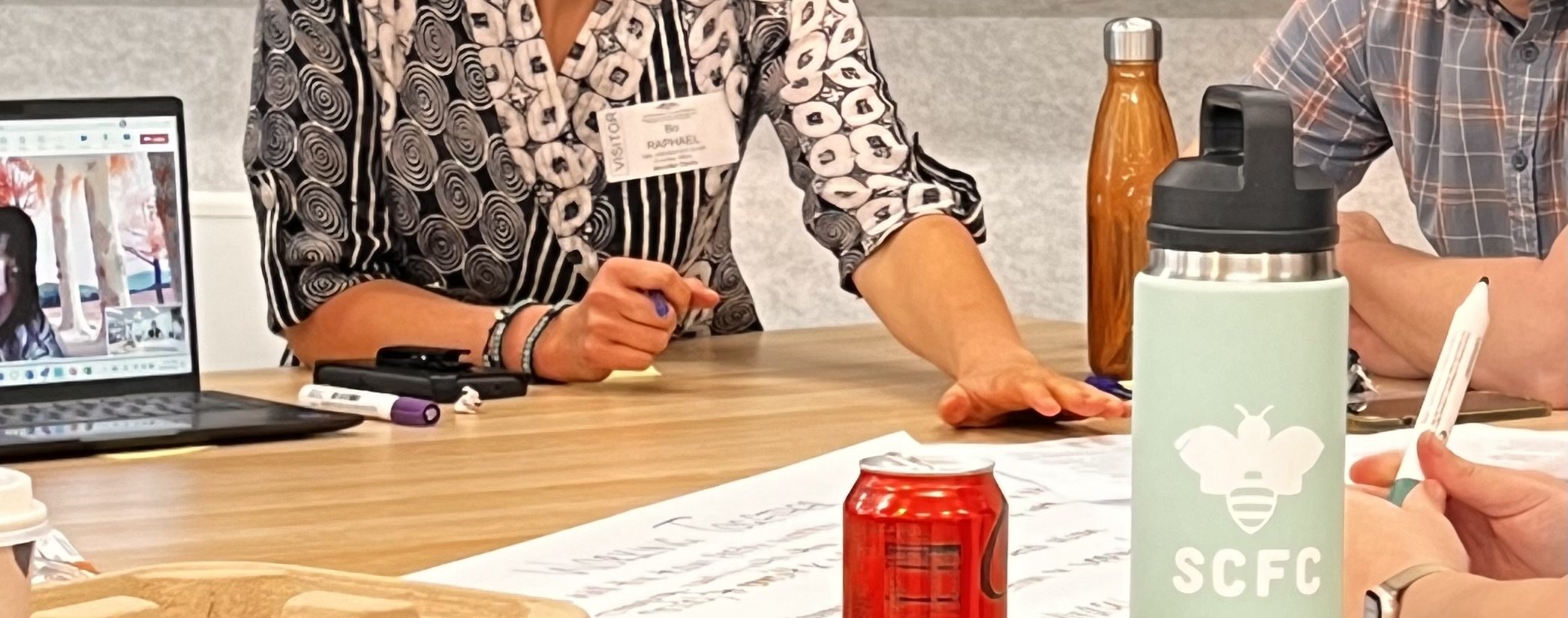
'table discussions'
Hybrid day-long Insightful Path designed/facilitated development day
“Thanks James, Foremost we wanted a day that engaged everyone, gave opportunities to connect, share and learn. You met these and successfully kept our 2 staff who attended virtually engaged and part of the group to the very end! ”
Skill 2: design for connection
A useful measure of a hybrid workshop is not simply whether remote participants remained connected to the call. It is whether participants felt more connected to one another by the end of the work.
That needs to be designed. Paired conversations, trios, rotating discussions and carefully structured whole-group reflection can all work in a hybrid setting. An online participant can join a pair or trio through a dedicated laptop. In a noisy venue, over-ear headphones can make that small-group conversation much more workable. Charging, room movement and audio arrangements should be planned before the day begins.
None of this is especially glamorous. It is good facilitation craft: anticipating the participant experience, reducing avoidable friction and protecting the purpose of each activity.
A delegate from a hybrid public service workshop reflected that the day created opportunities to connect, share and learn—and kept the two virtual participants engaged and part of the group to the very end. That is the standard: not technical attendance, but genuine belonging in the work.

Paired 'world cafe' activity within an Insightful Path hybrid workshop

Trio brainstorming within an Insightful Path hybrid workshop
“James was an excellent facilitator. I was impressed especially on how he got everyone to participate & include [our online attendees]. ”
Keep the design disciplined
Successful hybrid workshops still depend on the foundations that support good face-to-face facilitation:
· Clear communication. Instructions are concise, understandable and accessible from every location.
· Participative design. People have purposeful opportunities to think, speak, listen and create—not simply watch.
· Visible progression. Each activity advances the workshop objectives and gives participants a reason to invest their attention.
· Curiosity and care. The facilitator models openness, inclusion and enough lightness for people to work with real constraints.
Technology choices should follow these design choices. Use a tool because it helps people contribute, see the work or remain connected—not because a hybrid workshop is expected to look digitally sophisticated.
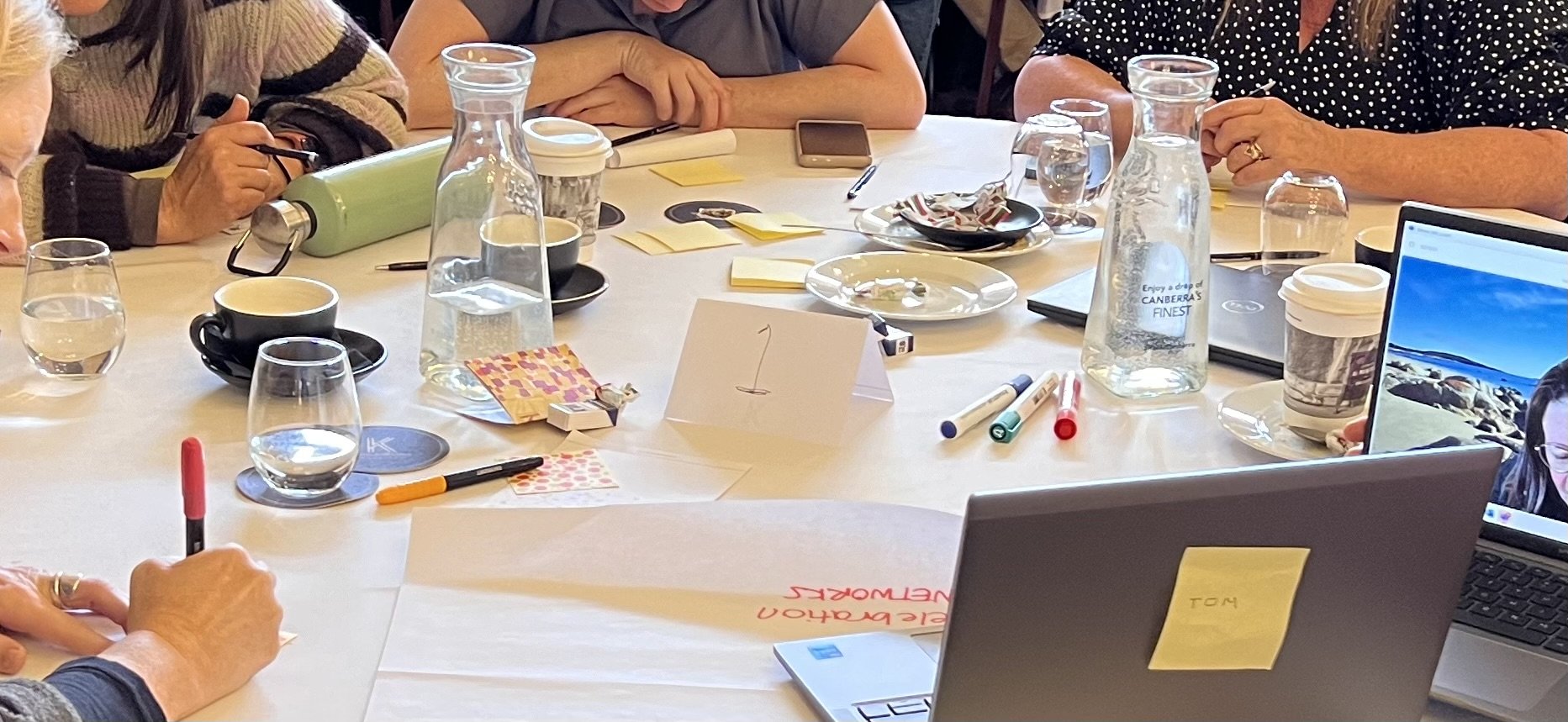
Table discussion within an Insightful Path hybrid workshop
A practical hybrid workshop check
Before the workshop, ask:
· Purpose: What must participants understand, create, decide or commit to together?
· Parity: Where might remote participants have less access to people, information, influence or informal conversation?
· Participation: How will every activity work for people in the room and online?
· Connection: Where will participants build relationships, not merely exchange information?
· Environment: Have audio, camera views, room movement, power, headphones and shared materials been tested in the actual space?
· Support: Who can monitor chat, troubleshoot and notice the remote experience while the lead facilitator holds the group?
· Contingency: What will we do if a device, platform or connection fails?
Human connection first, always
Hybrid workshops need not be difficult, and they need not rely heavily on technology. They do require an engaging and inclusive facilitator, supported by an engaging and inclusive design.
If some participants need to dial in, do not treat them as an exception to the workshop. Design them into it. Draw on the same human connection, clarity and care that make any facilitated process worthwhile—and be more intentional about how those qualities reach across the room and through the screen.

The last photo on a successful Insightful Path hybrid workshop
Continue your exploration
Related Insightful Path writing
Facilitation as a practice — An exploration of facilitation as an embodied, ethical practice—not simply a collection of techniques.
Truly innovative collaboration— Reflections on creating the conditions in which people can think and work together differently.
Putting these ideas into practice
Facilitation and its design — Explore how Insightful Path designs and facilitates workshops that build participation, clarity and meaningful action.
Beyond Insightful Path
Microsoft Research: Hybrid meetings guide — Research-informed guidance on power, participation and the practical disadvantages remote attendees can experience.
Perspectives: Creating Inclusive and Equitable Hybrid Meeting Experiences — A research study exploring co-presence, inclusion and cognitive load in hybrid meeting design.
IAF Core Competencies — The International Association of Facilitators’ framework for professional facilitation practice.
If you are planning a workshop where some people will be in the room and others online, Insightful Path can help you design the experience so that every participant has a meaningful way to contribute.
If you would like to have a pdf version of this essay, hit the button below: